
THE BARTONIAN
www.bartonians.uni4m.co.uk
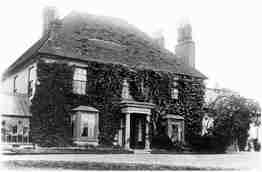
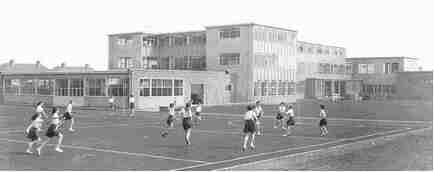
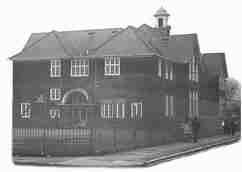
Barton Peveril 1918 Barton Peveril Grammar School 1957 (College from 1973) Eastleigh County High School 1932
____________________________________________________________________________________
_____Issue No. 50 Spring 2014
*****************************************************************************************
The Magazine for ex-pupils of Eastleigh County High School & Barton Peveril
*****************************************************************************************
Editorial Comment. Welcome to all our readers to this, our 50th Edition of The Bartonian. It is indeed the Spring Edition ! I’m not sure that there is much sign of Spring so far with weather that seems to have been giving us rain…and winds, since the end of last year, but here’s hoping for an improvement.
I am rather proud that we have achieved fifty editions. Our re-launch in 1997 seems a long way off but it is due to you, our readers, that we are still up and running. I don’t know whether many of you still have Issue No. 1 but here is an extract from Page 1.…….”.1. Please join us by sending your completed form and membership fee…….2. Please let us know what you would like from your Association in the coming months/years.”
You see, the message doesn’t change. Now, more than ever before we need your help. Membership numbers are of course slowly reducing but we need to keep going - with your help. Please be sure to stay with us, stay together and we will go on after Edition No. 51 ! Thanks. CHC.
_________________________________________________________________________________________
Barton Peveril College Today.
In the archives I have inherited from my illustrious predecessors I turned up ‘The Peveril’ from 1944. So, on its 70th anniversary, I thought I might find within it my theme for Barton Peveril in 2014.
The Headmaster, Mr Moore, delivered a report which dealt with the growing size of the school which was “fast over-flowing its buildings”. He referred to the growth in “geometric and technical drawing”. So how apt it is to refer to our ambitions to build a new science centre for the College providing us with state of the art facilities and space to expand our so called STEM (Science, Technology, Engineering and Maths) facilities. The project is on the drawing board and we are busy attempting to find a way of financing it. As for growth, we reach 2681 students this year so the Nobel Building is being put to good use!
After the Headmaster, the Right Honourable James Chuter Ede, Parliamentary Secretary to the Board of Education, is recorded as talking of “the future of secondary education”! In the past opportunities have only reached a limited class but now chances must be extended to all. This could only come with the institution of a just social system. Craftsmen and clerks must mix together in the same school, for the designer, the clerk, and the artisan were equally necessary for a balanced civilisation. Everyone must have an education suited to his individual aptitudes and the parent must not stand in the way of whatever was best for his child, but further his advantages in every possible way.”
The Peveril’s record of Speech Day 1944 records a pivotal moment in the history of state education in the United Kingdom. In August 1944, for the first time in five years, people dared to plan for a post war era and the ‘Butler’ Education Act received Royal Assent. It paved the way for free secondary education and, arguably for the first time, all children were given the right to a proper education, not just those who could afford to pay or were bright enough to win a scholarship. Perhaps reading this is a former County High School pupil who was in the Speech Day audience in 1944 ? Certainly others will have enjoyed the education offered at Barton Peveril as a direct result of the Act.
In 2014, we sit in the middle of another pivotal moment in the education of young people. Students arriving at Barton Peveril in September 2013 are the first for whom it is compulsory to be in some form of education or training up to the end of the academic year in which they turn 17. Then, from September 2015, it is compulsory to be in education or training up until their 18th birthday.
Yet strangely, the Secretary of State is looking to put the clock back: A levels must ape those set and sat in the 1950s by 15% of the population. The range of subjects should narrow and focus upon the traditional grammar school options. Students should study fewer subjects in more detail and assessment should be by terminal exams only.
We are in danger of undermining the very reform we should be celebrating 70 years after the Butler Act: for everyone to be studying in College side by side. Nowadays this is the website designer, the social worker, the engineer, banker, doctor or lawyer, male or female, black or white, with a learning difficulty or disability or not. For this we will need the most flexible curriculum that can engage, stretch, challenge and prepare our 16-18 year olds for employment and society in the 21st century. We need excellent facilities and buildings; we need an appropriate curriculum and a sensible means of assessment. Yet, despite our size, we must maintain what Mr Chuter Ede also recognised, “not a building but a body of people to which parents as well as teachers and scholars belonged”.
Jonathan Prest, Principal BP College.
______________________
John Hounslow has recently sent us copies of The Peveril and the 3rd Issue of an OBA News Sheet, for our Archive. The year 1944 for the former and 1951 for the news sheet. Going back to John’s time at ECHS it is interesting to note his modes of transport to and from the Schoo
”At that time I was living 4 miles the other side of Romsey. My journey involved riding a bike to town where I stashed it with a chap who ran a storage shed next to the Cinema. I then walked to the station, catching the train to Eastleigh (meeting up with the “Romsey lot” en route), then walking from the station to School. That, plus the return journey didn’t leave a lot of time for after school activities ! However, a bit before D.Day, my folks moved to Chandlers Ford, so I had a much shorter bike journey”.
Thanks John, I think they call that “the good old days!” Ed.
______________________
Tony Lawford (1948 - 1953) has sent the following and with an explanation why we haven’t seen it before !
I promised Cecil an article for the last magazine, but somehow did not get around to composing it, probably because I could not think of anything to write about. The winter issue of 2013, however, gave me a few ideas.
Richard Peacock, whose name I vaguely remember from my schooldays (he was three years my senior) mentioned days at the County Ground, and reading his remarks prompted my recollections. I think Mr Moore must have been a Hampshire member, since I recollect having a day off from school whenever the touring side visited Southampton, and my first visit to the County Ground in Northlands Road was for the Hampshire/New Zealand game in 1949. I remember catching the train to St. Deny’s station, and walking to the ground to meet up with others from our class to watch the game. I could not tell you one member of the Hampshire team of to-day, but can recall some of the Hampshire team of that day. McCorkell and Arnold opened the batting, and among the bowlers was Gerry Hill, and I think it was Derek Shackleton’s first season. We saw a lot of him in subsequent years. I can recall most of the New Zealand team, they were led by Walter Hadlee (the father of Sir Richard), Wallace was the vice-captain, among the bowlers were Hayes and Tom Burt. The batting included Sutcliffe, Scott, Rabone, Donnelly and Reid. The wicket-keeper was Mooney, who came and sat among the crowd during the afternoon. In my enthusiasm I collected their autographs. Hamsphire were all out for 129 in their first innings, and New Zealand scored well over 400 with Scott and Donnelly scoring centuries. Hampshire replied after tea on the second day with two cracking fours from McCorkell who was then out to the third ball. I was of course back at school the next day, and although they lost, Hampshire scored over 400 in their second innings, and made the New Zealanders bat again. From my recollection the cost of entry to the ground was 2s.6d. for boys, and 2s. for ordinary county matches.
The boys from our year met quite regularly at the County Ground over the next five years, leaving our bikes behind the stands at the stadium end. We remember seeing the great 1950 West Indies team with the three W’s, the South Africans and Australians. Another favourite fixture was the Whit Monday game when Hampshire always played Kent, when I recall the windmill like action of Doug Wright, the athleticism of Godfrey Evans, and the elegance of Colin Cowdrey. Cowdrey once lofted a ball onto the roof of the pavilion, a feat I saw equalled only once when Roy Marshall hit a six over our heads into the greyhound stadium next door. Hampshire had some good batsmen in those days opening with Marshall and Jimmy Gray and Henry Horton at number three. I recall that in one season they each scored over two thousand runs, perhaps it was the Championship year that Richard Peacock remembered. Of course there was the ever dependable Derek Shackleton who always took the new ball, and who always seemed to be plugging away at one end or the other. What a great bowler he was with over 100 wickets a season for 20 years. Among other Hampshire bowlers of my youth I recall Butch White, Peter Sainsbury and Reg Dare.
Now living in Banbury I have had no opportunity to watch Hampshire of late, indeed the last first class match I saw was at Edgbaston on 1994, and I don’t even recall Warwickshire’s opposition. Another reason for not watching much cricket is that I took up playing bowls when I retired, and that occupies a lot of time in the summer months. Mary Sharp (Penny) also provoked a few memories, but I will leave that for another issue.
Thank you Tony, it sounds like another article in the next Issue ! Hope you have not been following the Ashes Tour too closely!!! Stick to your bowls. Ed.
__________________
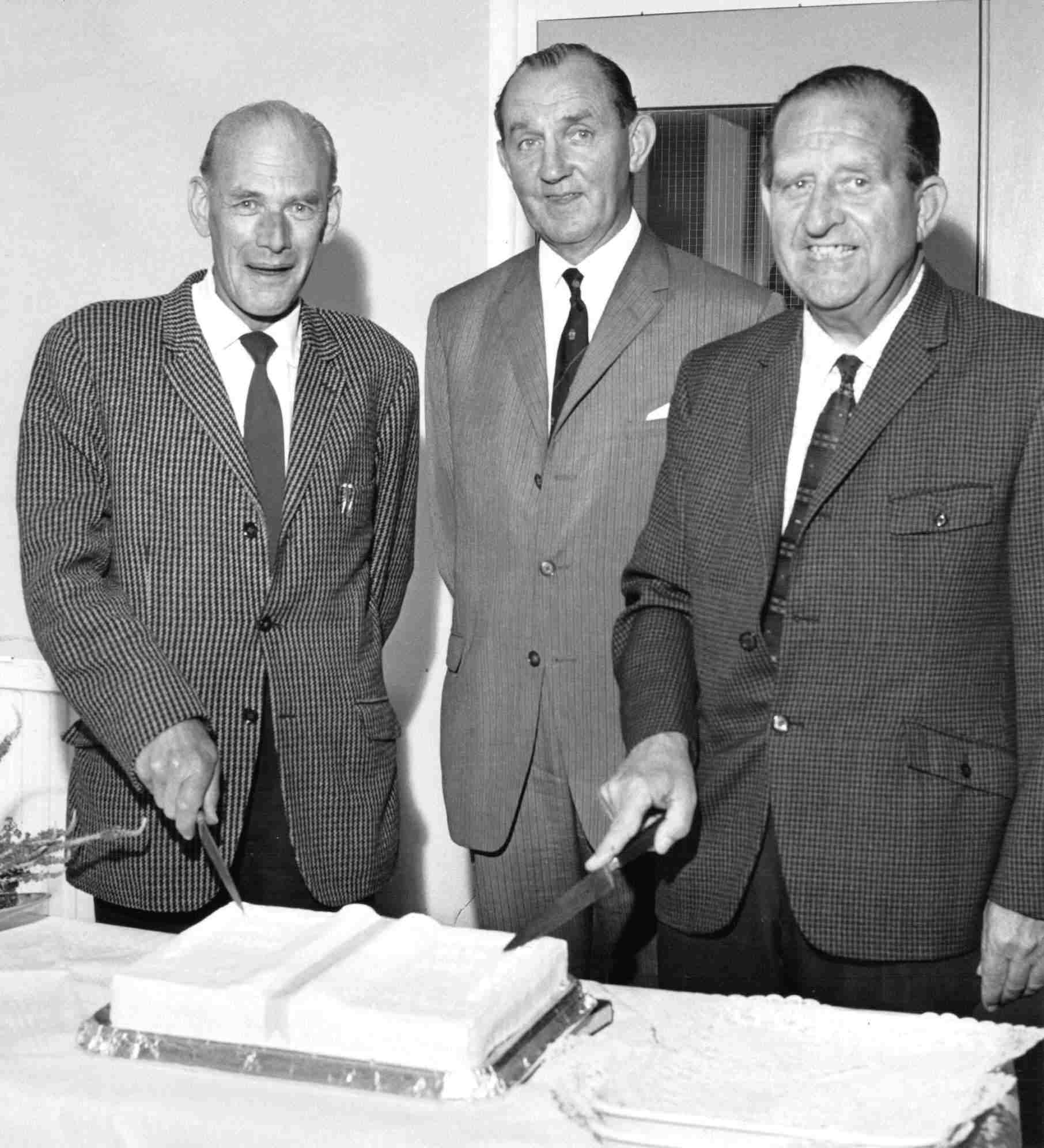
Do you recognise anyone in this photograph which was taken in 1971?
Michael Arnold (1945 - 1953) has sent the following article from Australia. It represents an extract from one of the chapters in a book he has written which is currently with publishers in the US. The title will be “Hollow Heroes”, looking at “the other side” of various personalities in World War II. Michael tells us the he was reminded of what he had written when he saw the piece about Alec Douglas-Hume and David Price. He warns that some of the issues mentioned may seem somewhat controversial but then the truth is often just that ! Ed.
Class and the British Army An important factor in Britain’s struggle to survive before America came to her rescue was the impediment of a system of social class that was evident throughout society and dominated the structure of military command. It resisted change or deviation from the orthodox and impeded innovation, initiative and invention.
Probably the most accurate description of the British army of 1939 can be found in Correlli Barnett’s ‘The Desert Generals’, and it is worth quoting: ‘It is generally true that an army is an extension of society; military disaster is often national decline exposed by the violence of battle. Examples are Imperial Russia and Austro-Hungary in the First World War, France in the Second. Any army thus reflects in sharp focus the social structure, the state of technological progress and the creative vigour of society. The opposing armies at Crecy illustrate this general rule. However the British army in the Second World War is an exception, perhaps the only one in history. Although the army of a twentieth century social democracy and a first-class industrial power, it was nevertheless spiritually a peasant levy led by the gentry and aristocracy. Its habits of mind and work, its mental and emotional life were those of the social order based on birth and lands that had passed from supremacy in the national life by the end of the nineteenth century. Few poor men of great ability chose the army as a rewarding outlet for their talents – pay for all ranks was less than an income … Men of great ability did of course make their careers in the army but, because it was a tradition of their caste and because they enjoyed private means. Therefore in a true sense, most regular officers in the British army were amateurs as well as gentlemen. Born into the gentry or the aristocracy, spending their lives in the last sanctuary of privilege in Europe, their mental characteristics and morality were not surprisingly very different from those of the managers, the scientists and technicians of industry. Cleverness, push, ruthlessness, self-interest and ambition were considerably less prized than modesty, good manners, courage, a sense of duty, chivalry and a certain affectation of easy-going non-professionalism. There was therefore in the British professional soldier little identification with the world of twentieth-century technocracy and little sympathy. They rightly judged it sordid and barbarous. But this did not help them prepare for its wars.’
Anyone who served in the British army during or for some time after the Second World War would readily recognise the truth of that description. Barnett might have added an affected style of speech, what cricket writer David Frith, when writing about a certain England captain of the 1930s, described as ‘strangulated upper-class vowels. ’This was a system that hardly ‘selected’ at all, it merely drew for its ranks from a small social strata ,as if background alone would guarantee the required intelligence, ability and initiative. It has been claimed in many quarters that it served Britain well; this is not true – if it served at all it was because that was the established order – but there is no evidence that it served well. It was what veteran journalist Wynford Vaughan-Thomas dryly referred to as ‘Eton in Uniform’ accents rather than acumen, breeding instead of brains and inheritance without intellect. Being a regular army officer in times of peace was rather like being a member of a fashionable cricket club but not getting out of the nets, and therefore never being tested; the style might be there but whether it would function in match conditions was another thing. Indeed the cricket analogy is particularly appropriate when one considers the amateur opposition to league cricket in the south of England before the Second World War. More than anything else this was because the amateur ethos balked at the prospect of real competition upsetting the comfortable atmosphere of their games. The same could be said of the easy-going and respectable profession in peacetime of what was referred to as the ‘officer-class’. As if this largely ceremonial environment was not enough of an impediment there was also a distinct resistance to and dislike of progress and change. Cartoonist David Lowe developed his 1930 character ‘Colonel Blimp’ after overhearing two military men in a Turkish bath agreeing that cavalry officers should be entitled to wear their spurs inside a tank. That such a notion could have been even a possibility sounds absurd today, but this nostalgic nonsense epitomised the establishment resistance to mechanization. This attachment to tradition was such that when cavalry regiments were forced to motorise in 1939 some, like the Royal Deccan Horse in India (albeit perhaps an extreme example), found that not one single person in that regiment knew how to even drive a car. Gentlemen either rode horses or took taxis or trains – cars were regarded as a mechanical nuisance.
Occasionally there were outstanding exceptions to this rule – Harding, later Field Marshal Sir John Harding, 1st Baron Harding of Petherton, whose school was Ilminster Grammar and who started life as a Post Office clerk - or Slim, later Field Marshal Viscount Sir William Slim of Yarralumla & Bishopston, schooled at St Phillips Grammar in Birmingham and who was a metal-works clerk before joining the army. So despite it being a socially closed shop it was still possible for those with ability to be accepted and succeed. Having said that this was only because of the exigencies of war, for both of the above had entered the army in 1914 and had built their careers from then on. At any other time given the prevailing social mores, men of Harding’s and Slim’s backgrounds could never have been considered. One must ponder therefore just how many others who would have made excellent leaders were passed over because of such a system. An observation has been made by respected American military historians and Harvard professors Williamson Murray and Allen Millett that the British army did not base promotion on effectiveness but rather on social class. In other words provided there was the ‘right’ sort of background, a successful army career was assured. A man might have been nondescript but as long as he conformed and ‘kept his nose clean’, then he could be confident that he would retire at least as a brigadier and perhaps even higher. Murray and Millett’s comment was undoubtedly made by comparing the respective social back-grounds of the American top military with that of the British. This seems to be borne out by looking at a random list of some of the American generals who fought or directed the campaign in Europe – Marshall, Eisenhower, Bradley, Patton, Truscott, Devers, Hodges, Bedell Smith, Gavin, Simpson, Gerow, Middleton and McAuliff. It will be found that only two came from backgrounds of some social advantage – Marshal and Patton – the families of the remainder being very ordinary, in fact some, Bradley for instance, came from backgrounds that were distinctly poor. However unlike the British military, social background does not appear to have been an obstacle to military career prospects in the American army, it had no effect on discipline and certainly did not influence performance. This does not mean of course that all American generals were outstanding successes any more than that all British generals were failures because there were successes and failures on both sides, but as a general rule it is self-evident that a selection process based on anything other than intelligence and leadership ability is more likely to produce failures. In this connection it is interesting to note that of all the English speaking countries who made a major contribution in the Second World War, ie, the United States, Britain, Australia, Canada, South Africa and New Zealand, it was only in the British army that there seems to have been the need for an officer to deliberately differentiate himself through accent and style of speech. This symbolic veneer seems to have been unique to the British army. In none of the others was there any discernable linguistic difference as between general, captain or private. General Omar Bradley, for instance, spoke just as any other Missouri born soldier, so too Bedell-Smith from Indiana or Patton from California and Australian General Morshead sounded like any other Australian, and so on. So, the question might be asked, why did British army feel that their officers had to sound different? Was it believed that their style of speech gave them an authority that they might otherwise have lacked? Was it thought, at that time at least, that a contrived style of speech would immediately be accepted as carrying authority? Or was it because having been selected and promoted because of social background rather than ability, many of them had little else to rely on? A large proportion of Britain’s military leaders had, historically, come from the nobility, who in many cases adopted an affected style of speech, so was it a case of a commission carrying with it the obligation to at least sound aristocratic? These are intriguing questions. Only in Britain was there a distinct strata of society recognised as the ‘Officer Class’. Membership of such elites may have conferred social prestige but militarily it was a weakness and was a source of operational problems when reality struck.
From about the beginning of the 20th century the British establishment had seen a degree of symmetry between their professed Christian gentlemanly ideals and that most ‘English’ of games, cricket. Grantland Rice was an American, and he was writing about American football, but his words about ‘when the last great scorer comes to mark against your name’ seemed to be so ‘cricket’ that they were adopted as though they were English. Add to that Henry Newbolt’s words of about the same time -‘Play Up, Play Up, and Play the Game’ - and there lay the perfect basis for the ‘play’ being more important than the ‘result’; in other words proficiency was less valued that attitude. Writing in the mid 1940s, George Orwell stated that ‘cricket gives expression to a well-marked trait in the English character, the tendency to value ‘form’ or ‘style’ more highly than success.’ This very English priority was in intention and effect little more than a device through which to ensure that despite increasing competition through egalitarianism, the right social class could retain control. Thus, in English County Cricket for instance, every county side was captained by an Amateur – a ‘gentleman’ - who was so different that he required a separate changing room from the professionals as if to ensure that he was not revealed to be exactly the same as anyone else or perhaps risk contamination by physical contact. When in 1926 the Daily Express offered the view that a professional captain was necessary if England was to win the Ashes cricket trophy against Australia, it was dismissed as bolshevism.
The 19th century had seen a new word enter the English language – socialism – and its portents threatened the controlling position of those who relied on privileged circumstances of birth rather than ability for their way of life. Thus in exactly the same manner as the British military, English cricket reserved a position of advantage and authority for those of the ‘right’ social background, and in the same fashion this priority was pursued irrespective of the effect it had on the success of the national team. As in the case of the army it was impossible to produce any actual results to justify the structure, and it certainly could not withstand scrutiny, so uncomfortable questions were either ignored or dismissed. Britain wasn’t exactly over-endowed with exceptional military talent during the Second World War, for although not in any way impugning their undoubted courage or fighting qualities, too many were staid and conformist and few had real ability when put to the test. There were generals and plenty of them, over two hundred in fact, many of whom were conventionally competent but little more. It would seem that it was this selection and promotion on the basis of class that was the main reasons why, even with Hitler devoting huge resources to the Russian front, Britain could make little impact on a homogeneous and modern German army until the advent of superior numbers and the industrial resources of the United States provided an advantage. On a one-on-one basis with Germany the effect of Britain’s class society meant she was unable to compete and such would have been the case even if there had been no war with Japan. The factor identified by Murray and Willett – social class being of greater importance than effectiveness - has also been one of the basic reasons for Britain’s decline as a world industrial power. Britain’s position of global strength by the end of the 19th century was due to her industrial revolution and this in turn was due to the inventive minds of engineers and scientists and the ingenuity and creativity of foundries and tradesmen, ordinary men all of them. It had been the same imagination and initiative of ‘ordinary’ men –Robert Clive, Stamford Raffles and Cecil Rhodes - who had claimed India, Singapore and large tracts of Africa for Britain. It had been entrepreneurial traders such as John Holt and the Lever Brothers who opened up West Africa for British business. None of these men felt constrained by ethics but were courageous opportunists spurred on by the vision of profit. Class attitudes have been the root cause of Britain’s notorious relations with her trade unions. Because of the social stratification of occupations Britain has not used her human resources to the best advantage and although recognised as an impediment, vested interests which benefit from the existing system have resisted any change from the status quo and have impeded the necessary moves being made.
In an interview in 1975, the Chancellor of what was then West Germany, Helmut Schmidt said: ‘British society, much more than the Scandinavian, German, Austrian and Dutch societies, is characterised by a class-struggle type of society. You have to treat workers as equal members of society. But as long as you maintain the damned class-ridden society of yours, you will never get out of your mess.’ Schmidt was Chancellor from 1974 to 1982 and might be noted that this comment was made just some thirty years after the end of the War and came from a country whose affluence and success was very largely being built on a cohesive society. With virtually no natural resources but due to the efficiency of that society Germany is now even further ahead of Britain than it was in 1975. The 21st Century has seen a slight change and greater egalitarianism but in the Second World War a rigid class system held sway and this purist orthodoxy was no more rigorously pursued than in the armed forces. Rigid to the extent that it was only with the greatest reluctance and when there was no alternative, that it might be diluted in the interest of efficiency; in fact protecting it if at all possible seemed to be of greater importance than winning the War. The practice of ‘class’ was not limited to the army. In his book ‘Fighter–The True Story of the Battle of Britain’ military historian Len Deighton recounts that RAF interviewing officers asked candidates if they were fox-hunting men, and ‘social tests’ being conducted in which a prospective officer candidate would be given lunch and plied with several glasses of sherry to discover if his language became no longer that of a gentleman. In the Navy it was known that a candidate appearing before an Admiralty Board was likely to be asked the registration number of the taxi he’d used. If this hadn’t been noted it didn’t really matter too much but if he said he’d arrived by some form of public transport, then he was clearly not the right sort. Today such trifling trivia sounds like the fiction of P G Wodehouse and Bertie Wooster but in 1940 it was all taken quite seriously. The industrial advances being made by other nations could be discounted as merely relative – they didn’t really concern Britain –after all Britain had an Empire on which the sun never set. There was however one scenario where the hollow shell of this comfortable class ridden complacency would be revealed, where the device of relativism was no shield and where reality would brutally expose it for what it was – war. There are no ‘relative’ evasions in the stark reality of war – you win or you lose. As an American might have put it – more important to be gentleman than a general, and to quote Correlli Barnett once more: ‘In this spiritually eighteenth-century army, the cavalry, as the arm of fashion and aristocracy, was the haughty queen. Over its stiff-necked elegance the heroes of the past nodded approval of a military code based not on technical competence, but on high birth, an esoteric way of life, and veneration for the horse. To these lancers and dragoons and hussars was to be given the oily, smelly, clanking product of a technical society: the tank. And with it they were expected to fight a homogenous German panzer arm composed of twentieth-century men of all social classes, who were more interested in sprockets than spurs.
Thank you Michael - lots to get our teeth into ! Ed.
Ivor Noyce (1944 - 1951) comments on the death last year of two Old Barts who gave great service to the community in their different walks of life……………..”Ian McArdle came to ECHS from Toynbee Road Secondary School in our fourth year. He went on to read Economics at Leicester University. Subsequent details of his life are not known to me, but Great Witt did keep in touch and I learned from her that he became Lord Mayor of Birmingham even giving her a lift in the mayoral car !
John Cranmer left School after taking his “O” levels, starting work at the Ordnance Survey followed by National Service. He then opted to train for teaching at King Alfred’s College in Winchester. During his time there and his first teaching post at Bishopstoke, he met and married my sister Janet. He moved on to teach in Southampton, taking an external Masters degree in Education. This enabled him to lecture at Gloucester training college, becoming Vice Principal at Rochester. His greatest achievement was to be appointed Principal of King Alfred’s, contributing much to the foundations of the transition of that College to University status. On retirement, he trained for the Church, becoming vicar at Crawley, Hants. Over 200 people attended his memorial service.
Thank you Ivor, we will remember them both. Ed.
_______________________________
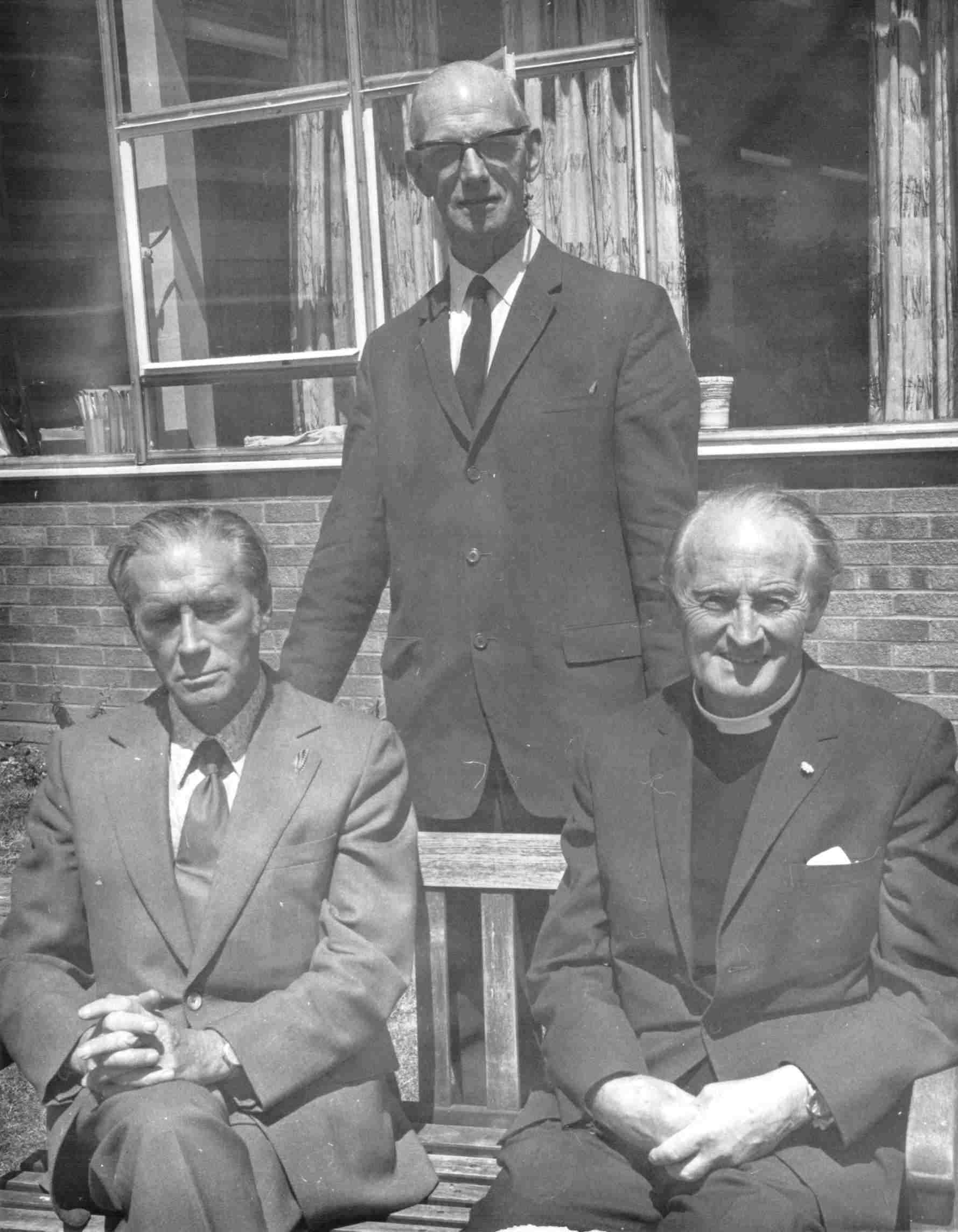
Do you recognise anyone in this photograph which was taken in 1975?
Dorothy Laverick (nee Brew) (1950 - 1955) , one of your present Committee has sent us her recollections of WW2.……………”One of my earliest memories was the night Coventry was bombed. My family had moved from Southampton when the bombing of the port of Southampton began. At first we stayed at the vicarage in a small village called Creaton, eight miles from Northampton, where the vicar was a friend of my mother.
After a while, possibly due to friction between vicar and “guests” (mother and three young children) my mother found an empty farm worker’s cottage with thatched roof, two rooms up and two rooms downstairs plus an outside toilet. There was no electric or gas lighting in the living room leaving candles and a range in the kitchen for cooking. As the waves of bombers started droning across the skies towards Coventry my mother brought us all downstairs and sat the three of us in the two big leather armchairs either side of the fireplace. All night long waves of planes continued to pass overhead until dawn broke the following day. I daresay we all must have dozed off at times during the night. Neighbours who watched from the highest point of the village said they could see the rosy glow of Coventry burning.
Another memory of living in the village concerned Sunday lunch times. At around eleven o’clock the local ladies, my mother included, would leave their homes with the Sunday roast in their roasting tin surrounded by batter for the Yorkshire Pudding, taking it to the local baker where they would all be cooked in his large bread oven. The reverse process occurred when they all had to collect their meals and take them home for the family dinner. At the age of 4½ years old I started at the village school. It was held in a single room with two teachers. A block of four single desks, one behind the other for each year group with a screen dividing the four youngest classes from the four older. Sums were done on a slate with a piece of chalk. About this time we had an evacuee from London to stay with us. One weekend when her mother was visiting her one of the first V2 doodlebugs landed in the middle of the village. The only damage it managed to do was to break all the windows in the village. Our evacuee’s mother knew immediately what it was on hearing the engine cut out. We had no siren warning of bombing raids in the village, the nearest siren being in nearby Northampton. The editor of the Daily Mirror reported the occurrence in his paper. He later served a prison sentence for letting the enemy know that their V2 rockets were reaching as far into England.
Recently, on Armistice Day I was watching on the News the clips of ships being sunk as well as other programmes showing the convoys of merchant ships being escorted by the Royal Navy. This brought it home to me the ordeal my own father went through in the War. My Dad was a radio officer on a Union Castle liner sailing between Southampton and South Africa, calling at Capetown, Port Elizabeth, East London and Durban before returning. On one of these trips his ship was torpedoed and sunk. He spent the next 48 hours on a raft. The only item he had taken with him was a photo of his youngest child, my youngest brother Phillip. At the time I was told about this, I was too young to appreciate his ordeal. At the end of the War our family returned to Southampton. Thank you Dorothy - They say, “Seeing is believing”, how true. Those wartime memories will never leave us. Dorothy has promised more. Now you all know, she will keep that promise - I hope ! Ed.
I think you are describing the V1 Dorothy, the V2 would have dropped down on your head from a great height at a speed of approx.2,100 miles per hour! JCB
___________________________
John Foxwell (1945 - 1952) sends the following article prompted by his scrutiny of several editions of our Magazine The Peveril. Not surprisingly he calls it “Fancy That”…………….
THE PEVERIL school magazines published during the war years make for some fascinating reading as I discovered in the process of digitising the magazines for the Old Bartonians’ website (www.bartonians.uni4m.co.uk)
Not surprisingly school life was very different in that period. For example one reads in the June 1940 edition that the girls have been knitting for the forces. In fact so far they had delivered 227 items to the Royal Navy including pullovers, mittens, sea-boot stockings, scarves, caps and steering gloves (presumably this was done in the curriculum, under the heading of ‘Domestic Science’)- a noble and beneficial contribution to the war effort. Everybody was encouraged to do their bit. The school magazine editors themselves suffered from a shortage of paper which severely limited the size of the magazine-yet another example of wartime rationing. The magazine obtained some of its income from advertising in particular the Welch’s Sports shop in Eastleigh High Street who apologised during the war for shortage of supplies and after the war because goods were going to boost exports. In a 1942 edition, Edwin Jones,-a supplier of school uniform- were advertising girls summer frocks at 8/11 (42p) and matching knickers at 3/3 (16p).
Because of the wartime paper shortage only a limited number of contributions from pupils could be accommodated. This was particularly disappointing for those whose literary efforts failed to get published. The poems and stories written by the pupils were of a very high standard. After the war contributions were more numerous and in themselves are well worth a read-even if the more mundane current goings-on in the magazine would not mean much to those of us who were not actually at the school at the time. One amusing wartime piece relates to evacuating the school when the air-raid siren sounded. In these circumstances the whole school would be required to abandon classrooms and troop out to the air-raid shelters situated close to the pavilion in the school playing field in Passfield Avenue. For some this was, no doubt, a welcome relief from ‘double Latin’ or the like.
Major H.N.R. Moore, The Head, in his military capacity was instrumental in forming the School Army Cadet Force; later he also formed the 11th Hants Cadet Unit with 6 platoons and the formation of the 11th Hants Cadet Battalion with A, B and C Companies. Major Moore was obliged to relinquish the Command of the Battalion because of the pressure of his work in connection with the Home Guard .
THE PEVERILS of 1944/45 list the Roll of Honour of those old school pupils who gave their lives; also recorded is the many old pupils currently on active service. The editorial in the December 1944 edition points to the impending fall of Hitler and the return to peace in Europe. A 1945 editorial discusses the excitement surrounding the forthcoming general election and the polarisation in the School between those supporting ‘the Blues’ and those supporting the ‘Reds’
The activities of The Old Bartonians’ figured in THE PEVERIL throughout the war and after. 1948 maybe the first reference to our Chairman, Cecil Churcher. So Cecil, it would seem that you have been associated with the Old Bartonians for well over 65 years-surely a record for any society. It is noted that you were a very early (if not the first) Secretary of The Sports section which was instrumental in raising the annual Association subscription from the princely sum of1/6 (7½p) to the outrageous sum half a crown (12½p)- a rise of around 66%!
December 1945 saw a reunion of the Upper Fifth (1944-45) at which, in appreciation by the handicraft boys, and to wish him every happiness in his forthcoming marriage, a Biro pen was presented to Mr Almond (an outstanding woodwork teacher). Although the original invention of the ball-point pen was in 1888 the 1945 model was the first really successful one; it could be regarded as a technology breakthrough and paved the way for the virtual abolition of pen and ink.
When I joined the school in 1945 one of the big changes from the primary school was that, instead of a class teacher who dealt with all subjects, we now had separate teachers for each subject. One of these teachers was Miss (Olive) Meakins whose subject was history. Miss Meakins was a young teacher but I did not realise at the time that she was a quite recent ex-pupil of the school. In 1940, as a pupil, she revealed “an acting ability which cannot be said to have had full scope previously “when she played the part of Lady Bracknell (of ‘handbag’ fame) in a School production of ‘The Importance of Being Earnest’. She was an excellent teacher and I enjoyed her lessons but had to give history up at the end of the third year in favour of science subjects where my real interests lay.”
Thank you John - well, fancy that ! 1948 marked my return to civilian life. It was that year when, whilst waiting for demobilisation in York that I received Registration Forms to join the Old Bartonians Football Club, thanks to the late Ted Parker. Ten years of success followed - happy days ! Ed.
_________________________
It is with sadness that we announce the passing of Olive Pounds (né e Jenman) (1924-29) at the ripe old age of 101 years. Her centenary was reported fully in the Autumn /Winter edition (Issue 47) of the Bartonian but I would like to add that she served on the OBA Committee for many years and, with the help of Sue Coleman, ran the Tombola at the annual reunions; the profits from which usually enabled us to break-even on the day. JCB
_________________________
In our last Issue we promised a closing chapter for the tale we have been telling of “The Boat”. True to his word, Doug Hannah has sent us, what he called a precis of the rest of his story…………
“My original script goes on to describe at some length our domestic life on Horsburgh Island. The enemy never paid us a visit, so, as far as I was concerned, it was idyllic. The climate was just about as perfect as it could be. We were only 12 degrees south of the equator, so there was little difference between summer and winter. I went in the sea every day, walking round the island when I was not on duty - yes, right round. It did not take very long as it was only about a mile in diameter. At the time I wrote long descriptions of the islands and their history but now readers who are sufficiently interested can visit the Cocos Keeling Islands website and read it all in much greater detail. There are even a few photographs. Look at the map of the islands and click you magnifier on the tiny dot near the top of the group and that is my island. You can even make out a little blue dot in the centre of the island - that was the pond in the middle of the jungle.
The war in Europe came to an end. It made no difference to us. We were 129 Staging Post set up ready for the assault on Japan. Our Liberator bombers and long range Mosquitoes carried out raids on Japanese shipping and airfields in occupied territories. The Americans then dropped the atom bombs and it was all over.
If you can locate a copy there is an illustrated paper back “Operation Pharos” by Ken Rosam published in 2001 by Woodfield Publicity which describes the Islands in some detail and their part in the 1939 - 1945 war.
Of course we couldn’t all go home just like that. The Far East was full of British and other Service personnel. We remained on our little island until Christmas 1945 and were then evacuated to the main camp on West Island. However, after a week or so, with virtually no notice, I was to make my first ever flight in an aeroplane - and a jolly long flight it was too ! - in a Liberator bomber back to Ceylon. A fortnight’s leave in the Hill Country gave me a chance to see something of this former colony and then I played about with wireless equipment in the Colombo area waiting for a boat to the UK.
I arrived home in June 1946 and found my old job rather tame to say the least after life in the RAF. Incidentally I became Secretary of The Old Bartonians Association for several years with Mr. Percival as my Chairman). However, I did finish up back in uniform as Chief Officer of the Hampshire Ambulance Service and was once again involved with vehicles and radio communications.
My life on a remote coral island in the Indian Ocean is still a vivid memory. What an experience it was as 1455006 Corporal Hannah ! “ Many thanks Doug for this and previous contributions - we have enjoyed your story. Ed.
__________________________
Derek Baker (1941 - 1945) sends the following memories of ECHS days……… “ It was September 1942. Three years into the Second World War. England was not alone - we had the United States and Russia as allies but we had not yet had the victory in North Africa at El Alamein.
I was 11 years old and had survived my first year at the Eastleigh County High School and was now starting my second year in the 3rd. Form. We has a new English teacher - Mrs.Stone - the wife of the senior maths master “Pop” Stone. Mrs Stone brought to the school as one of her objectives to improve the diction of pupils. Many of the girls spoke quite nicely but as a generalisation many pupils spoke with the rather lazy South Hampshire drawl - a touch of an agricultural burr with an element of a London accent.
Apart from quite properly correcting our speech as we answered questions in class Mrs Stone had the idea of forming a poetry choir in which a number of pupils recited in unison. I think this experiment was conducted in one class only - my class of 3A and it completely dominated the English lesson for a term or so. We did of course fit in other aspects of the English language - some Shakespeare, some poetry, grammar and essays but for lesson after lesson groups from within our class were called to the front and recited in unison. Various pupils - boys with deep voices - were weeded out and we were left with a choir of about 12 or 14 pupils. I can’t really remember all the names but I believe it included Vic Morrow, John West, Vera Holloway, Gillian Cooper, Mercia Moody, Freda Stickley, Peggy Cousins, John Hounslow and myself. I apologise for not remembering the names of some and possibly for including the name of a person who was not actually a member of the choir. I recall that Tony Whale, one of the Romsey boys, gave a little introduction like a prologue in a Shakespeare play. The chosen poem was “Follow the Fife and Drum”. It was the story of a defeated, dishevelled army on the retreat when one of the soldiers came across a toy shop and started playing a toy drum. Another soldier played a toy whistle pipe and together they stirred the retreating army into life. I cannot remember all the poem but I recall it included: “Wheedle deedle deedle dee, come boys come, you that mean to fight it out wake and take your load again - fall in, fall in - follow the fife and drum”.
After many rehearsals during English lessons -we gave - if my memory is correct,-three performances. One at school at assembly, one on Speech Day and one in the Eastleigh Town Hall at some featured event. We come across group chanting in some classical plays but I have never met a simple poetry choir.
As I have said before, this was a very prominent feature for our class for a term or so. However, many years after I had left school I spoke to Mrs Stone at an Old Bartonians Reunion Dinner. I mentioned the poetry choir which was so significant in the life of my class 3A and to my astonishment she had no recollection of her creation “!!
We are glad you remembered Derek and thanks. Ed.
_____________________________
The following comes from Mike Smetham (1944 - 1951) , seeking your comments…………..
“I seem to have run out of accounts of my rule bending, rule breaking, and downright dishonest activities which I used to smooth my passage through school, so as we are ex-pupils of a GRAMMAR school, in my old age I will express my disquiet regarding what appears to be a corruption of our language.
It is very commonplace now for the word OFTEN to be pronounced OFFEN. Very noticeable with people being interviewed on television. Another word which seems to be under threat is STRENGTH which is being pronounced as STRENTH. I am sure that there are other words which my fellow readers have noticed and would like to write in about. There has been introduced a new use of the word GIFTED. The dictionary says this means talented, but the word is now used to mean GIVEN, another point for discussion.
A different matter altogether, on the Saturday morning "Sounds of the Sixties" music show, a short reference was made regarding a Jimmy Grant living in Bournemouth, well into his nineties but still able to rattle off a good tune on the piano. Could this be "our" Mr. Grant who taught us maths in the Lower Fifth? I don't think he was with us very long, but certainly at school concert he showed a complete mastery of the piano, and it was no surprise to learn that he had moved on to the music industry. It is surprising to think that at my age there is still one of my former teachers about the place.” Hoping that there is some reaction to my grammatical gripe !
So do I Mike, thanks for your contribution. Ed.
_______________________________
HUMOUR.
Jokes have been “thin on the ground” for this Edition but determined to raise at least a small smile, here goes…….. I’m afraid that you can’t escape some of the Christmas Crackers from our Annual Dinner !What should a prize-fighter drink ? A Punch.
What clothes do lawyers wear in Court ? Lawsuits.
What do you get if you cross a skeleton and a detective ? Sherlock Bones.
Why did the rooster crow before daybreak ? His cluck was too fast.
What do you call a row of men waiting for a haircut ? A barbecue.
Where can you buy British Rail bubble gum ? On a Chew Chew train.
Do you give in ? right, here goes . The following comes from our USA correspondent, featuring Irish jokes - never quite sure why the Irish figure in these kind of stories………..
Paddy and Murphy are working on a building site. Paddy says to Murphy, “I’m gonna have the rest of the day off. I’m gonna pretend I’ve gone nuts”! He climbs up the rafters, hangs upside down and shouts “I’M A LIGHT BULB”! Murphy watches in amazement ! The foreman shouts “Paddy you’re mad - go home…so Paddy picks up his gear and leaves, to go home. Murphy starts packing his gear to leave as well. “Where are you going ?” asks the foreman. Well, says Murphy, “I can’t work in the dark, can I”?
Paddy, the electrician, got sacked from the US Prison Service for refusing to service the electric chair……He said, in his professional opinion it was a death trap !
Paddy and his wife are lying in bed and the neighbour’s dog is barking his head off, in the garden next door.
Paddy says “I can’t stand this” and storms off. He comes back upstairs five minutes later and his wife asks, “So, what did you do?” Paddy replies, “I’ve put the dog in our garden……let’s see how they like it !”
Mick and Paddy are working in a cemetery. Mick says, “Crikey ! there’s a chap here who lived to 152 !”
Paddy says, “What’s his name?”……Mick replies, “Miles, from London”!
I guess that none of us like insults……except……when they are made by the famous !………
“He has all the virtues I dislike and none of the vices I admire.” Winston Churchill.
“I have never killed a man, but I have read many obituaries with great pleasure.” Clarence Darrow.
“I am enclosing two tickets for the first night of my new play; bring a friend…if you have one! - George Bernard Shaw to Winston Churchill. “Cannot possibly attend first night, will attend second….if there is one “ ! Winston Churchill, in response.
“Some cause happiness wherever they go; others, whenever they go” Oscar Wilde.
“I’ve had a perfectly wonderful evening. But this wasn’t it”. Groucho Marx.
“He has Vangogh’s ear for music”. Billy Wilder.
Have you ever heard of “Groaners” ? Here are a few……….When fish are in schools, they sometimes take debate. A thief who stole a calendar got 12 months. When the smog lifts in Los Angeles U.C.L.A. The batteries were given out free of charge. A dentist and a manicurist married. They fought tooth and nail. With her marriage, she got a new name and a dress. When you’ve seen one shopping centre you’ve seen a mall. These come from our USA correspondent - we have to blame someone !
______________________________
In this Issue, my thanks go to Michael Arnold, Derek Baker, John Barron, John Foxwell, Doug Hannah, John Hounslow, Tony Lawford, Dorothy Laverick, Ivor Noyce, Jonathan Prest and Mike Smetham. Your enthusiasm is much appreciated.
The Committee looks forward to seeing you during 2014
Friday 9th May - Our Annual Dinner
at Eastleigh College
Saturday 10th May - Reunion & AGM
Please support us by being there!