
THE BARTONIAN
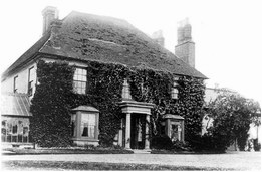
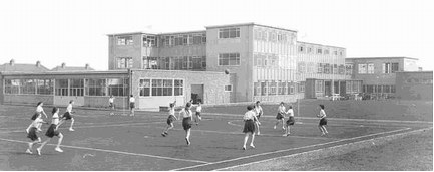
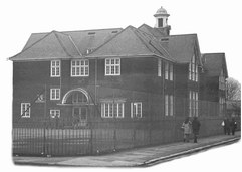
Barton Peveril 1918 Barton Peveril Grammar School 1957 (College from 1973) Eastleigh County High School 1932
_________________________________________________________________________________________
Issue No. 54 Summer 2015
*****************************************************************************************
The Magazine for ex-pupils of Eastleigh County High School & Barton Peveril
*****************************************************************************************
Editorial Comment. Hello once more and thank you for taking the time to read our magazine. In this Issue we have two quite long articles and a few smaller. You will see from my “thank yous” at the end that the number of contributors has shrunk ! This can only mean one thing - we are shrinking. I hope it doesn’t mean that we are sinking !!. For one more time I ask for your stories, please. Well, our May reunion has come….and gone. I know it is an annual affair but, to me, it seems a six monthly one…time speeds by so quickly. Thank you for coming if you were one of 50 or 60 who did. Our numbers are shrinking but each year seems to bring us closer to appreciating what it means to still be an “Old Bart”. The College environment has played its part in bringing us even closer for the last two reunions. News of one member who was unwell in May’s meeting - he is now fine. Whether you come to our Skittle evenings or Quiz Nights in the future, I look forward to seeing you then. All the very best of good fortune to you all. CHC.
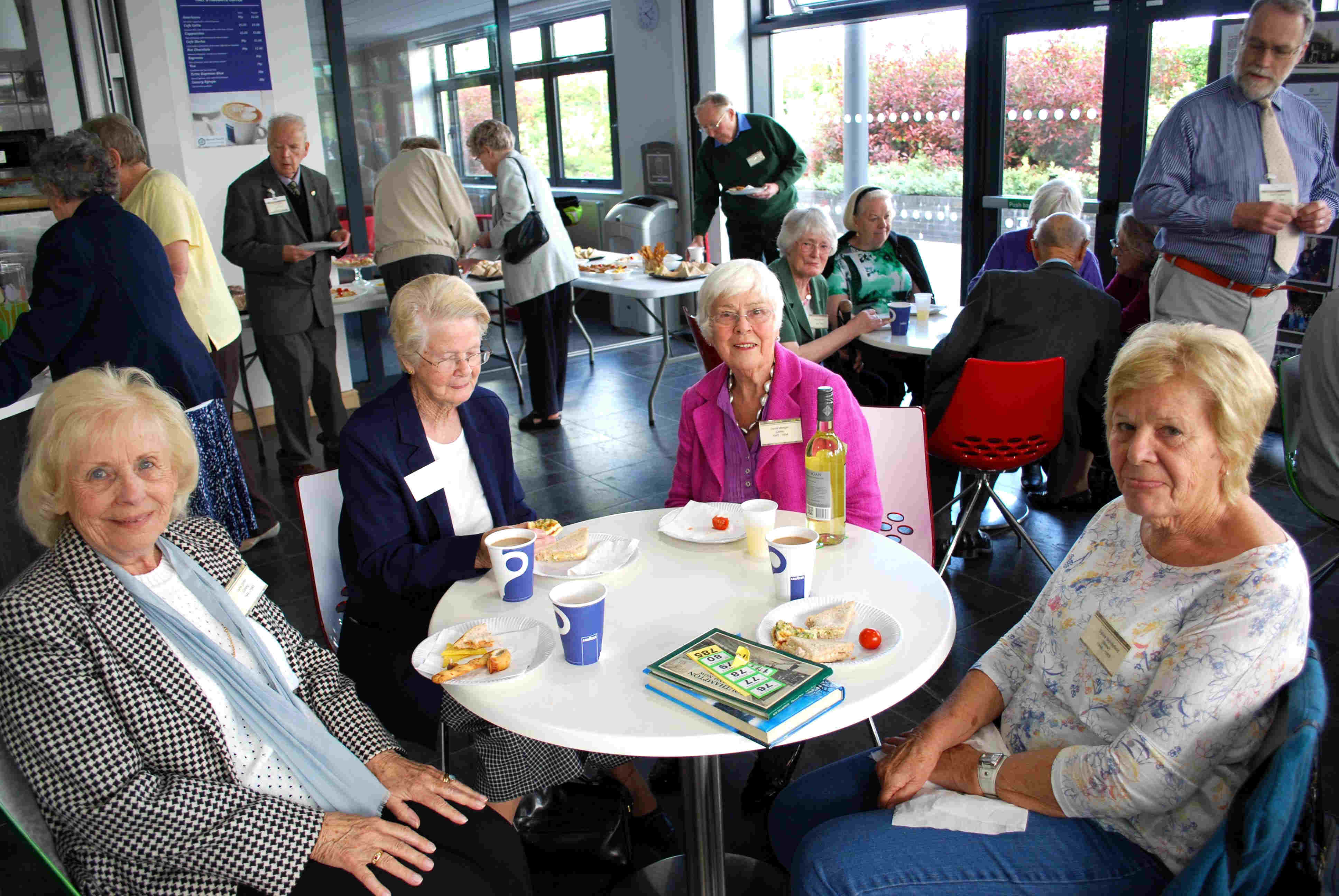
June Griffin (Girling) Gillian Lowton (Reynolds) Janet Meager (Delia) Sylvia Bondsfield (Brew)
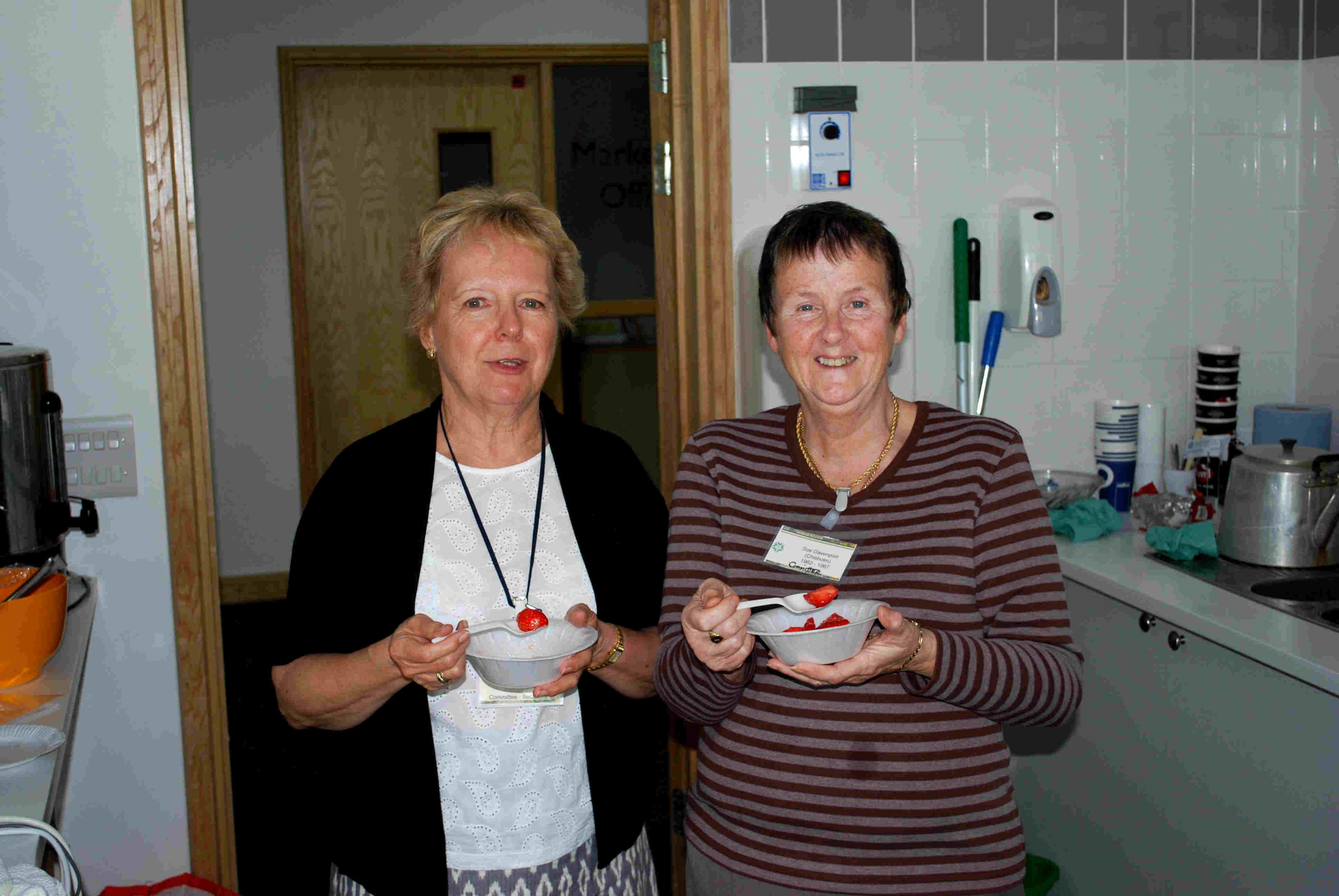
OBA Secretary Lorraine Bondarczuk (Parker) and Committee Member Sue Davenport (Chisholm),
who prepared a delicious high tea enjoying some of the “fruits of their labour “- strawberries and cream!
Barton Peveril College Today.
Once again my report starts with a thank you to the Old Bartonians: your generosity will once again help support younger Bartonians with their gap year plans. It was a pleasure to see many of you at the AGM and tea in early May.
At College over the past few weeks the emphasis has been upon staff training and development - taking advantage of the exam cycle and several weeks when students are not in their scheduled lessons, giving us an opportunity to bring staff together and reflect upon our practice. Much of the focus has been upon how we encourage our students to work harder, to become more independent, and to be better prepared for the futures.
A survey of student work habits suggests that students are not working so hard outside of their lessons as we would expect and, with the pressure of results and performance, teachers are trying to compensate by ever more effective teaching in class. The risk is that our staff are working ever harder, and our students progressively less hard!
So we are aiming to create a community in College which engages students with the pleasure of learning. Lessons are being turned on their head and students are being asked to come into class having done ‘pre-work’ rather than sent away to rehearse a skill or learn a concept taught in the lesson. Hardly new, you might say, for where did the word preparation or prep come from if it wasn’t getting yourself ready to learn? The theory is that when students find out something for themselves they have invested more in the process instead of being passive disengaged recipients of facts like those in the class of Thomas Gradgrind, Dickens’ insensitive, utilitarian teacher stereotype in ‘Hard Times’.
Anyone who has done any teaching will have experienced that realisation that you never really know your subject until you have taught it, or at least been able to explain it clearly to others. So asking students to learn something then come into College and explain it to the class or a small group of peers can be a huge incentive to getting to a higher level of understanding. Some of our staff have even started a technique called ‘flipped learning’ where they occasionally record an explanation or thoughts on a topic, place it on the internet and ask students to have ‘watched the lecture’ before they arrive at the lesson to discuss it further.
But to create a college where students really become immersed in their learning requires a rich culture of discovery, questioning and thinking to surround young people. We believe teachers, too, must be engaged in learning and developing themselves, sharing the delight they get from research and reading, acting as role models for their students. It is also important that parents show an interest in their children and what they are studying. Parents can help with wider cultural, sporting and academic opportunities through trips to the theatre, concerts, galleries etc. and they can help provide fertile conditions to study at home.
The culture at Barton Peveril is one of the healthiest I have come across in colleges but we are determined to broaden and enrich it, to ensure students work as hard as teachers, and young people have an education which prepares them for a bright future.
Jonathan Prest, Principal BP College.
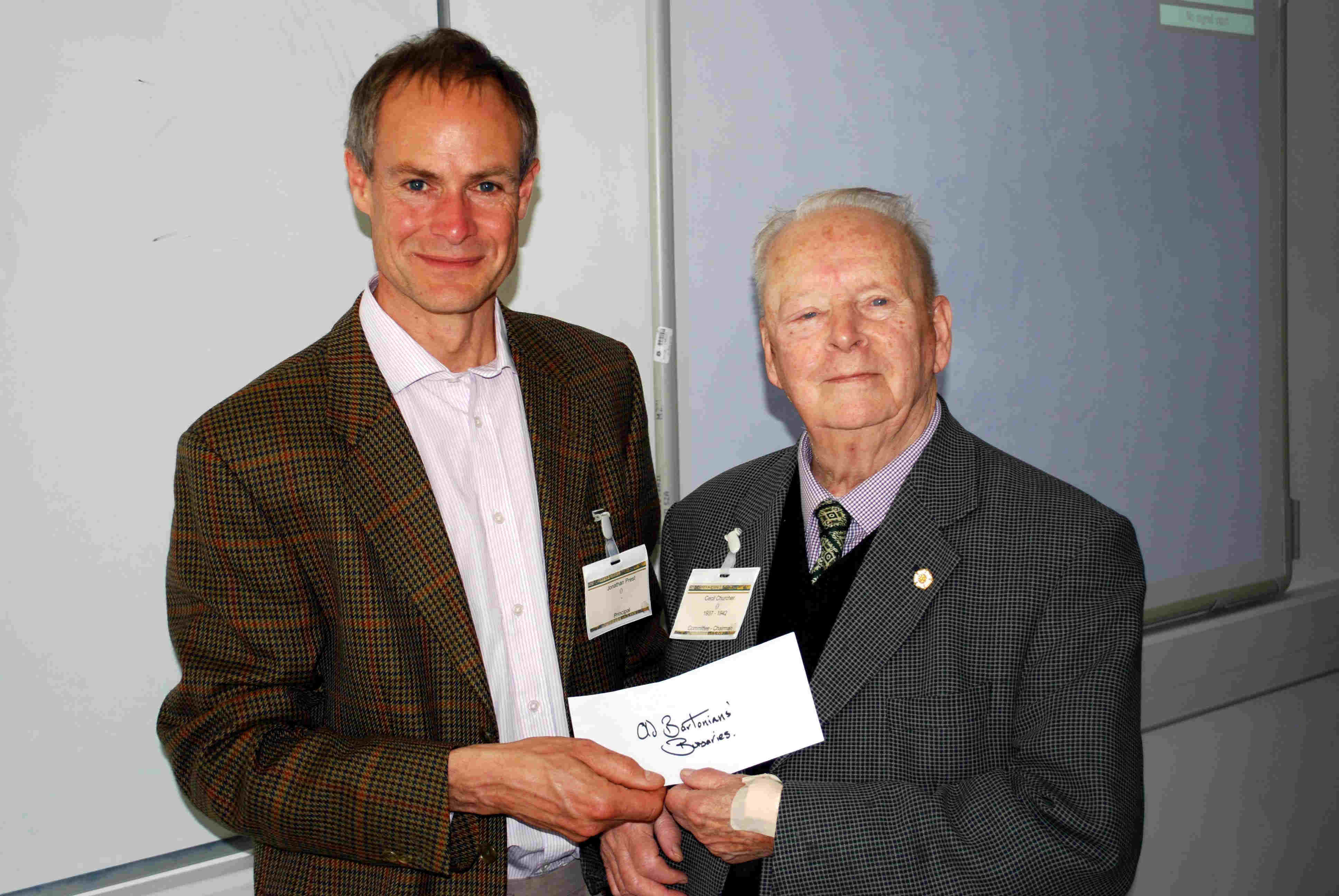
Jonathan Prest, Principal.BP College, being presented with a cheque for £1000 by our Chairman Cecil Churcher.
Carolyn Rogers
(Dawes) (1961 - 1963) has sent us the following article which she calls School Reunions and Famous People. see how many you can count ! Ed.As many of you may know, probably one of our most famous ex-Barton Peveril pupils is Colin Firth, who I believe does mention the school in his biography. Anyone who attended the reunion in May 2010 will remember that he was there! Well, not really, only a cardboard cut-out of him from the film ‘The King’s Speech’, but a friend took a photo of me standing next to this, which does look quite real!
This reminded me of another school reunion of mine in 2008.I attended three different grammar schools, as we moved around the country in the 1950’s & 1960’s, the first being in Cornwall, the second in Lincolnshire & the last being Barton Peveril. The 2008 reunion was at Poltair School in St Austell, Cornwall, which in my days there from 1957-1958 was known as St Austell Girls’ Grammar School, with the Boys’ Grammar School being next door.
The reunion was a special one, being the centenary of the school’s opening. I heard about it from a friend of mine, Jenny, who also attended the school, but we did not know each other in those days, but in more recent years through our interest in doll-making. We met at the British Doll Festival held at Fawley Court in Henley-on-Thames in 2001 & have been friends ever since. She still lives in St Austell & invited me to stay for a couple of days so that I could attend this reunion which was being held at the Eden Project. Despite being June, the night of the reunion was pouring with rain. Another ex-pupil friend of hers, Rod, drove us there and we went into the reception area at the top, where we registered, before getting the little train down to the main biome where the reunion was taking place. I met up with twins Jean and Josie, who I had not seen since our school days and have remained in contact with them and see them on our frequent Cornish holidays. There was live music and places to eat, in all, a lovely evening.
There were fireworks to round off the event and as the rain had now stopped the three of us decided to walk back up the path to the car park whilst watching the fireworks. Suddenly I heard Jenny say ‘That was funny, Nettles being here!’ I could not believe my ears, ‘What did you say?’
I asked her. ‘John Nettles’ she replied. ‘I saw him when we were registering’. Unfortunately, she did not tell me and I did not see him at any time, so had no idea he was there! I was pretty upset, being a big fan of his! Although I knew he was originally from St Austell and had attended the boys’ grammar school, I had no idea that he would be there! To this day I’m still so upset not to have met him and cannot understand how it was not at all important to my friend that he was there! I would have been so excited and would have had another autograph to add to my collection.
In fact Jenny is used to mixing with famous people. Her best friend Rachel is Jo Wood’s mother (Jo being the now ex-wife of Ronnie Wood of the Rolling Stones). I’ve met Rachel a few times, as she is also a doll-maker and was with Jenny when we first met. At the 2007 Doll Festival in Henley, on the Saturday evening there was the Gala Dinner, presentations of awards for all the competitions for various categories of making dolls, teddy bears, etc., ending with live music and dancing into the early hours. When Debbie, the event organizer, was doing the presentations, she mentioned that unfortunately Jenny and Rachel were not there that evening as they had a previous engagement in London - Ronnie Wood’s 60th birthday party! Jenny drove Rachel to London and they got back later that night, as Henley is not that far from London.
Another friend I met through the Doll Festival, Judith, lives in Norfolk and we meet up with her on our annual holiday there, is the ex-wife of actor Jack Shepherd, star of the Cornish-based detective series Wycliffe, played Hugh Grant’s father in About a Boy, lots of other film and stage roles, and most recently a couple of weeks ago one of the guest stars in Midsomer Murders (unfortunately now no longer starring John Nettles!).
Cornwall is a very popular place for filming and I have always been fascinated by the process of film-making. Charlestown, an unspoilt harbour near St Austell, just down the road from where I lived in the late 1950’s, has been used many times for film locations. Twice in recent years we have watched filming there, by companies from abroad. Well known films and dramas using Charlestown as a location include The Eagle Has Landed, Charles Darwin - The Voyage of the Beagle, A Respectable Trade, The Three Musketeers, Moll Flanders, Rebecca, Frenchman’s Creek, Scarlett Pimpernel, Mansfield Park and many others. As far as I can see from the trailer, the new version of Poldark has also used Charlestown.
In 2009 we watched some of the filming of Doc Martin with Martin Clunes in Port Isaac in North Cornwall. It was not the warmest of days and a couple of girls who were extras, dressed in shorts and tee-shirts as it was supposed to be summer, were cuddling hot water bottles between takes!
Laurence Llewelyn-Bowen has a home in Port Isaac and his wife has a ladies clothes shop there.
I have met him on two occasions in our local department store in Newbury when he has been promoting his cutlery. The second occasion was later in 2009 when I received one of his spoons on a card written by Lawrence to me with love and also one of the assistants took a lovely photo of me with him! On the first occasion around 2004, I made an excuse to take an early lunch from work so that I could see him. I asked him if I could kiss him and he said Yes, so he got a kiss on the cheek and I got a spoon from that collection, also signed by him.
I will go back many years now to various sports people I have been lucky enough to meet, mainly because I was married to a flat race jockey, Trevor, for 19 years, from 1968. Footballers are often horse racing fans so over the years met quite a few. Trevor knew Peter Osgood who played for Chelsea, so often met up with him when at Windsor Races. Robert Morley, the actor, could often be seen enjoying the races at this venue. In the 1970’s at Royal Ascot we met Alan Ball and Kevin Keagan with their wives and used to see Mel Smith at Bath and Newbury Races.
I was a huge football fan in the 1950’s, following Aston Villa and going to see them when playing at Villa Park with my father, as we lived in Birmingham. The goal-keeper, Nigel Sims, was my hero and I have an autograph book with all the players’ signatures from that time which he sent to me, as he had lost my original book I had sent him to get all the players’ autographs. Aston Villa won the FA cup in 1957 against Manchester United, with Nigel Sims in goal.
Because the flat racing season lasts from March to October, jockeys go abroad to ride during the winter months. In the mid-1970s we met Pele in Nairobi when he paid a visit to the Norfolk Club where all the jockeys and families spent a lot of time during the week swimming, playing backgammon and relaxing, as racing only took place at weekends. I have his autograph in my collection.
We also got to know two wonderful women when living in Nairobi, Michaela Denis & Beryl Markham. Michaela Denis, with her husband, Armand, filmed wildlife documentaries which
were shown on TV in the 1950’s and early 1960’s and she also wrote books. Trevor had met
Michaela and got talking to her and she invited us to visit her at her home. My mother and her friend, Mary, were coming to stay with us for a month in January 1978, so we arranged for all of us to go. We spent a lovely afternoon having afternoon tea in her garden and hearing about her experiences. She showed us around her home, pointing out interesting things she had collected. She lived alone, as Armand had died in 1971 and she died in 2003.
Beryl Markham was a racehorse trainer and Trevor used to ride some of her horses. Although often not remembered, she was one of the first bush pilots and a pioneer aviator; she was the first woman to fly solo across the Atlantic from east to west in September 1936. She was also the first licensed female racehorse trainer in Kenya. We went to lunch with her one day in the mid-1970s and my sons were slightly taken aback to find that the meat being carved for our main course was a whole tongue! It was delicious and we all enjoyed our visit. Her memoir ‘West with the Night’ is a wonderful read, as is the biography by Mary S Lovell ‘Straight on Till Morning’ and ‘The Lives of Beryl Markham’ by Errol Trzebinski. Stephanie Powers played the title role in the film ‘Beryl Markham: A Shadow on the Sun’. She died in 1986 aged 83.
Being a great lover of the natural world, spending three winters in Kenya was wonderful, getting the chance to see the wonderful animals roaming wild. One of the racehorse owners Trevor rode for was Ari Grammaticus, who owned Governor’s Camp in the Masai Mara Game Reserve, so we were lucky enough to fly there for a few days and go out on game drives to see the animals.
It was used as the headquarters for the TV series Big Cat Diary which had several series between 1996 and 2009.
One of Ari’s sons, Damian, is now a BBC journalist on TV and radio but I remember him as a young boy in Kenya and on our return to the UK we visited the family in Kensington and took Damian and his brother, with my two sons, to the Science Museum, just nearby.
The Royal Albert Hall in that area of London is the best place ever for concerts and I have been many times. In the early 1970’s, with another jockey and his wife, we went to see Andy Williams, who was enjoying great success in this country at that time. We had great seats and as we sat down to enjoy the show realised that sitting just behind us was Ronnie Corbett and his wife Anne!
We got chatting to them and I have the souvenir brochure of the show signed on the front by Ronnie Corbett.
For the past 50 years Eric Clapton has played concerts at the Royal Albert Hall - this year he returns in May to celebrate his 70th birthday. In February 1991 I saw a review in the Telegraph from his previous night’s performance and thought ‘Oh no, I’ve missed booking it again!’ I was at work, but thought it was worth a chance, so rang the Royal Albert Hall to see if any seats were available and there had been a cancellation in a box, so booked it - for that night! It was cold and had been snowing but Jon, my partner, and I drove up that evening, managing to park nearby. We were inside walking around looking for the door to our box when coming towards us was Richard Branson with his wife and family, who we later saw were sitting in the box next to ours. The concert was brilliant & Phil Collins played drums.
I have seen Cliff Richard several times at the Royal Albert Hall and will be going again on
14 October this year , which is actually his 75th birthday. I have been a fan since 1958,
when he, along with other singers such as Adam Faith and Billy Fury were always on the pop shows and in the music charts during those early days of British pop music. In the late 1990’s Adam Faith toured as the narrator with the show ‘A Chorus Line’ and I went with a friend, Joan, to see this show at the Hexagon in Reading. At the end of the show they announced that Adam Faith would be happy to meet fans at the stage door, so we were thrilled to be able to chat with him and get his autograph. He and Joan were reminiscing about places and music in London in the 1960’s and I joked that she was really a Cliff Richard fan! He was so friendly and charming and obviously delighted to chat to his fans. How sad that he died so young at the age of 62 in 2003.
Another star who died young, 66, was Davy Jones of the Monkees pop group. He was born in Manchester, as was my ex-husband, Trevor, and they met when both worked in racing stables in Newmarket in the 1950’s and Davy rode his first race at Newbury when he held an amateur riders licence. In around 1984 he paid a visit to Newbury racecourse, where he met Trevor after all those years and I also met him. I remember chatting to him while walking from the stands across to the car park after the end of racing.
Without a doubt, the most exciting snooker player we’ve ever seen, who also at the age of 14 was working at a racing stables in the hope of becoming a jockey, was Alex Higgins. He worked at the racing stables of Eddie Reavey at East Hendred, nr. Wantage, Oxfordshire. Trevor rode for this stable in the 1980’s, when Eddie’s wife Jocelyn had taken over the training. Alex was playing in a snooker tournament at the Hexagon in Reading and visited the stables and got to know Trevor, who was a keen snooker player. One afternoon in 1984 they went to play golf together and came back to our house. I had just cooked a Chinese meal for dinner and he happily ate my food on a tray, sitting in an armchair in the lounge! He was quite chatty and my sons were over the moon to be able to get his autograph and obviously ask their friends ‘Guess who came to dinner?’. They went along with their Dad to watch him play at the Hexagon. Alex also died at the early age of 61 in 2010.
I have enjoyed remembering all these various talented people I have met or nearly met! They were all very different, fun & interesting. Agreed, Carolyn. Many thanks for your contribution. Ed.
________________________________
It is with great sadness that we report the death on 10th May of our oldest member. Lily Valentine Cull (Biddy) (1924 - 1929) at the age of 101. One of our “Golden Oldies” she always showed interest in our Association and its activities. Bishopstoke and all of us has lost one of its treasured friends.
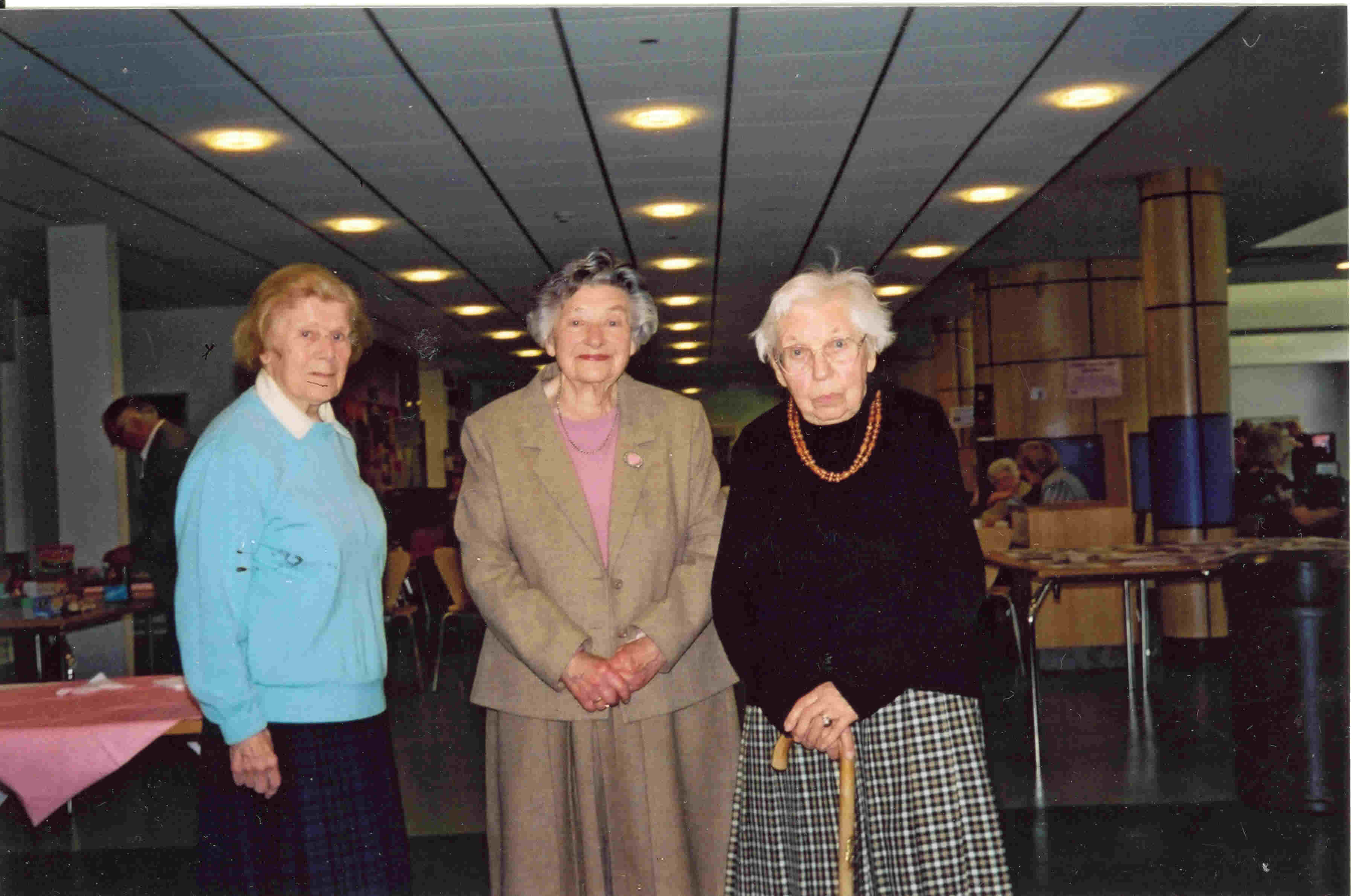
Olive Pounds (Jenman) Lily Cull (Morris) Bess Crumpling (Wadden)
Biddy with her classmates Olive and Bess at our reunion at Barton Peveril College in 2005
________________________________
Michael Arnold (1945 - 1953) has sent us the following contribution. He tells us that his book, “Hollow Heroes” is now on sale. It was from this book that we published a chapter “Class and the British Army” in our Spring 2014 issue.. In addition you may remember that the first chapter of his current book, “Imperial Atrocities” was in our Autumn/Winter issue. Michael says that this book is nearing completion and the final chapter of that book follows………..Michael suggests that it may not make for pleasant reading but it just goes to show that the evil men were not always on the other side…………..
Epilogue - MacArthur v Yamashita & Homma
An avidity to punish is always dangerous to liberty. It leads men to stretch, to misinterpret, and to misapply even the best of laws. He that would make his own liberty secure must guard even his enemy from oppression; for if he violates this duty he establishes a precedent that will reach himself. A Dissertation on the First Principles of Government. Thomas Paine 1795.
It would be nice if we could leave it there – Japan is now a worldly culture, the Emperor has literally been brought down to earth and the country is an affluent industrial leader. But, largely hidden or overlooked in the transformation accomplished in the years that followed the Japanese surrender in August 1945, there lies a squalid episode where America was complicit in a deliberate conspiracy to execute two innocent men. What happened was not the result of official policy, but came about because Washington found it more convenient to look the other way whilst their Pacific hero, Douglas MacArthur, was allowed to commit the most heinous of crimes for purely personal reasons.
Thomas Paine was one of the Founding Fathers of the United States and is much quoted for his aphorisms relating to the principles that should guide the new nation. The above observation was cited at the front of Lawrence Taylor’s 1981 book ‘A Trial of Generals – Homma, Yamashita, MacArthur’ for it encapsulates the fundamental principle that was at stake in the odious tactics employed by MacArthur to obtain convictions against the two Japanese Generals. This was not simply victor’s justice – it was vindictive vengeance.
These two 1945/46 ‘hearings’ against Yamashita and Homma represented the lowest point in General Douglas MacArthur’s Pacific War, a campaign during which and through carefully selected announcements and media control he had done his utmost to portray himself as the genius who alone would win the war. A man of unbridled and ruthless ambition and conceit, the performances of MacArthur’s troops had in fact been matched, if not exceeded, by those of Admiral Chester Nimitz and the marines and pilots of his aircraft-carriers; everyone heard of MacArthur – the name of Nimitz rarely appeared. But having been appointed the complete supremo for Japan, MacArthur made sure he would have everything his way.
Neither of these hearings was a ‘trial’ in the accepted sense of the word. They were both military tribunals hastily assembled and personally directed by MacArthur in order to obtain convictions and death sentences in Manila before the official War Crimes Tribunals were convened in Tokyo. MacArthur wanted the two tribunals to be concluded as quickly as possible in order that the accused would have no time in which to assemble a complete defence, time which they would be allowed if they were to appear before the official Tokyo War Crimes Tribunal.
All Members of the Manila Tribunal were serving US army officers and were personally selected by MacArthur. None of them had any combat or legal experience and many still had years of service ahead of them. MacArthur had also delegated the appointment of the prosecution and defence.
All the criminal procedures and rules of evidence to be followed by the Tribunal were drafted by MacArthur. The usual rules of evidence were considered to be ‘obstructionist’. Hearsay, and even second or third party hearsay evidence would be accepted. Thus neither of the defendants was allowed the opportunity to cross-examine many of the so-called ‘witnesses’ produced by the prosecution. Article 13 of MacArthur’s directions stated that ‘the Tribunal shall not be bound by technical rules of evidence. It shall adopt and apply to the greatest possible extent expeditious and non-technical procedure, and shall admit any evidence which it deems to have probative value. All purported admissions or statements of the accused are admissible’. Added to his directions was one that stated; ‘The official position of the accused shall not absolve him from responsibility, nor be considered in mitigation of punishment. Further, action pursuant to order of the accused’s superior, or of his government, shall not constitute a defence’.
So blatant was the intent that in the opening address the prosecution stated that ‘the Articles of War are not binding upon, and do not apply to this Commission. This Commission is not a judicial body: it is an executive Tribunal set up by the Commander-in-Chief’.
MacArthur had a deliberate plan to ensure the conviction of individual Japanese commanders, and prime examples were those of Generals Tomoyuki Yamashita and Masaharu Homma. Yamashita was known as the ‘Tiger of Malaya’ an acronym claimed by the West to refer to his brutal tactics in that country. The truth is that it was not the Western press but the Japanese media who had first coined the phrase to applaud his rapid success in the Malayan/Singapore campaign. However his popularity in this operation provoked the anger of General Hideki Tojo who shunted Yamashita off to a remote posting in Manchuria in 1942.
Yamashita was plucked from Manchuria and had arrived to assume overall command of the futile defence of the Philippines on 10th October 1944. Ten days later the US launched their invasion at Leyte and with almost total control of air and sea began their inexorable assault on the rest of the island archipelago – a result so inevitable that the final death toll was 336,000 Japanese as against 14,000 American. Yamashita was personally targeted by MacArthur and accused of having been responsible for the massacre of civilians during the chaotic final collapse of the Japanese defence of Manila in February 1945.
Realising that he could not defend Manila, Yamashita had moved his headquarters to Baguio, high in the mountains and over three hundred km north of the city, roughly the distance of New York from Washington. Because of danger to civilians he gave orders that Manila was to be abandoned without combat, and all troops withdrawn to the mountains to the north and east where a defence could more effectively be organized. This order was ignored by Rear Admiral Sanji Iwabuchi in Manila who directed his ill-disciplined marines to fight on to the death and in doing so these men indulged in an alcohol fuelled frenzy of rape, mutilation and killing.
It is established fact that responsibility for the atrocity lay squarely with Iwabuchi, who acted on his own initiative and disobeyed Yamashita’s overall authority, but he had died in the fighting. The reason for Iwabuchi’s fight-until-death order appears to have been his need to atone for the sinking of the battleship Kirishima whilst he was in command of that ship in November 1942. The Americans were aware that Iwabuchi was to blame but since he was dead they targeted Yamashita instead. The underlying reason for MacArthur’s malevolence seems to have been revenge for Yamashita having made MacArthur’s retaking of the Philippines so difficult. In his book ‘Victor’s Justice, the Tokyo War Crimes Trial’ Richard Minear writes:
‘It is inevitably the case that only defeated leaders risk trial. In the words of Chief Prosecutor Keenan: “The recipe for rabbit stew is first to catch the rabbit”’
This was a tasteless analogy that did little credit to the speaker, but such was MacArthur’s impatience to catch his ‘rabbit’ that on his direct orders Yamashita was charged barely three weeks after the formal surrender in Tokyo Bay and proceedings against him were commenced in Manila just four weeks later. This was fully six months before the International Military Tribunal Far East was first convened in Tokyo, a fact that speaks for itself.
When first arraigned, on 8th October 1945, Yamashita was presented with a list of sixty-four charges. When his trial began just three weeks later a further fifty-nine charges had been added. Although it was admitted by the prosecution that it taken them three months to investigate and assemble all their charges, the pleas of Yamashita’s defence team for additional time to look into these one hundred and twenty-three charges were summarily denied.
In Europe the Nuremburg Trials did not commence their Hearings until over six months after Germany’s surrender and yet Yamashita was executed at the end of February 1946, two months before the Tokyo Tribunals had even begun. To add to the impression of predetermined and hastily convened proceedings, is the fact that the fluent Japanese speaking British Colonel Wilde who was mentioned Chapter 16, Japan Freedom from Colonialism, had already interviewed Yamashita at length in connection with Japanese actions in Singapore and was impressed by his character and integrity.
The Americans were also aware of this, and yet they, i.e. MacArthur, would not allow Wilde as a witness for the defence. It was a mockery of justice, one of the dissenting tribunal members describing the verdict as ‘legalized lynching’. Yamashita was not indicted because he was guilty - he was there because he’d lost. MacArthur wanted an early example of his authority and to achieve this he couldn’t risk the gradual accumulation of evidence that might have thwarted his objective – and at that time there was nobody to stop him, or at least no one of sufficient authority who was interested.
As an added twist and MacArthur rarely missed an opportunity for political symbolism, Yamashita’s conviction was handed down on 7th December 1945, four years to the date since the strike on Pearl Harbour – an attack in which Yamashita took no part.
Yamashita’s conviction was appealed to the US Supreme Court. A cable was sent by Yamashita’s defence team requesting a stay of execution until the Court had had time to consider the appeal. The US Secretary of War radioed MacArthur suggesting he should delay the execution until the Supreme Court had made a decision; MacArthur flatly refused. The Secretary then ordered MacArthur to postpone the hanging and MacArthur had no option but to comply.
When Yamashita’s case was heard by the US Supreme Court theCourt stated, by a majority, that they had no power to intervene. This was not agreeing with the verdict but merely side-stepping the issue. But one of the dissenting judges, Justice Frank Murphy succinctly observed:
‘The probability that vengeance will form the major part of the victor’s judgment is an unfortunate but inescapable fact. To subject an enemy belligerent to an unfair trial, to charge him with an unrecognised crime, or to vent on him our retributive emotions only antagonises the enemy nation and hinders the reconciliation necessary to a peaceful world’
And Murphy went on to say:
‘The petitioner was rushed to trial under an improper charge, given insufficient time to prepare an adequate defence, and there was no serious attempt to prove that he had committed a recognised violation of the laws of war. He was not charged with personally participating in the acts of atrocity or with ordering or condoning their commission. Not even knowledge of these crimes was attributed to him’.
The prosecution alleged that even if Yamashita was unaware of the Manila atrocities, he should have been. This conveniently ignored the fact that it had been the successful object of the US army and air forces to disrupt communications and cause widespread confusion, an issue on which the aforesaid Justice Murphy had commented:
“We, the victorious American forces, have done everything possible to destroy and disorganize your line of communication, your effective control of your personnel, your ability to wage war. In these respects we have succeeded. We have defeated and crushed your forces. And now we charge and condemn you for having been inefficient in maintaining control of your troops during a period when we were so efficiently besieging and eliminating your forces and blocking your ability to maintain effective control. This indictment in effect permitted the military commission to make the crime whatever it willed, dependent on its biased view as to petitioner’s duties and his disregard thereof”.
It may simply have been a coincidence but just four days before Yamashita’s hastily convened trial, the Philippines had become one of the founding countries of the United Nations and it was a land where MacArthur had served several terms. One month after the initial Japanese attack in 1941 MacArthur had received US $500,000 from Philippine President Quezon. The ostensible reason for the payment of such a large amount, roughly $5 million in today’s money, was ‘in recompense and reward, however inadequate, for distinguished services rendered between November 15 1935 and December 30 1941. . ‘Distinguished services’ presumably included allowing virtually all of his aircraft to be destroyed in one day.
Was the speedy conviction of Yamashita also a reciprocal gesture of gratitude? A few months after his execution the Philippines was granted full independence by the United States. As a side issue here, MacArthur’s receipt of Quezon’s money was totally against United States military law; Roosevelt knew about it but did nothing. Was this because allowing the Japanese to make first strike in the Philippines in 1941 had been a confidential Presidential order?
In their book Gold Warriors the Seagrave’s describe Yamashita’s trial as a grotesque miscarriage of justice:
‘He was charged with war crimes because of the atrocities committed, against his explicit orders, by Admiral Iwabuchi’s sailors and marines in Manila. The tribunal in Manilla was not composed of men with legal degrees, and only hearsay evidence was offered to link Yamashita to the crimes. Nonetheless, the prosecution was badgered by MacArthur’s headquarters to quicken its pace, to minimize court procedure and allow hearsay evidence.’
While waiting for the Manila Commission to return to the Courtroom with a decision, newspaper reporters milled round discussing the possible verdict. Although there were over fifty reporters there to hear what the verdict would be, only twelve of them – American, British and Australian – had covered the entire trial from the beginning. The fact that twelve of them had heard all of the evidence struck Pat Robinson, the correspondent of the International News Service, as significant. He polled the twelve-man ‘jury’ in a secret ballot: Was Yamashita guilty? The vote was 12 to 0: No.
Following the Supreme Court decision a final appeal was made to President Truman, in his capacity as Commander-in-Chief of all American Armed Forces, but in typical peremptory style Truman wouldn’t even look at it.
At 2.30 in the morning of 23 February 1946 General Tomoyuki Yamashita was hanged at a specially constructed gallows in a jungle clearing near the little township of Los Baños about fifty-five km south of Manila.
A similar case was that of General Masaharu Homma who, like Yamashita, was indicted before an all American military Tribunal in Manila and charged with the brutalities of the Bataan Death March in April in 1942. Homma had commanded the 1941 Japanese invasion of the Philippines and in fact had ordered his troops to treat the Philippinos not as enemies but as friends and had also publicly stated that POWs should be treated fairly. For these directions he was criticised by the Japanese High Command and posted back to Tokyo and by the time of the Bataan march he had already been removed from command in the Philippines.
His trial, for which he was extradited to Manila from Japan on the specific orders of MacArthur, was a parallel travesty to that of Yamashita and it prompted another comment from the same Justice Frank Murphy, who said:
‘Either we conduct such a trial as this in the noble spirit and atmosphere of our Constitution or we abandon all pretence to justice, let the ages slip away and descend to the level of revengeful blood purges’
As had been the case of Yamashita, MacArthur had a personal grudge against Homma. His bungled defence of the Philippines resulted in the defeat he had suffered at Homma’s hands in 1942; it was not only the very first defeat in MacArthur’s long career, but it had also been one that was inflicted by a much smaller force.
Homma was arraigned for the first time on 18th December 1945. His Defence was presented with 47 charges. The trial was set for 3rd January 1946, only sixteen days away, a period including Christmas. MacArthur’s prosecuting team had been working on these charges for some months. The Defence requested more time in which to investigate the charges, but as in the case of Yamashita the reason for the request was understood by the Tribunal but was summarily refused without any reason being given. The proceedings then moved inexorably on to their inevitable conclusion.
At midnight on 3rd April 1946 General Masaharu Homma was executed by firing squad at the same gallows enclosure that had seen Yamashita dispatched some five weeks earlier. As a ‘gesture’ to Mrs Homma MacArthur had decreed Homma be granted the honour of a firing squad instead of the gallows. The International Military Tribunal Far East was due to convene in Tokyo on April 29; MacArthur had his two rabbits out of the way with a few days to spare.
Generals Yamashita and Homma had both been victims of the new offence of ‘command responsibility’, a crime that had been specifically introduced so that irrespective of any circumstances top commanders could be indicted for the behaviour of their troops. As the Pacific War Historical Society explains:
‘The culture of fanaticism and extreme brutality encouraged in the Japanese military between 1930 and 1945 was calculated to produce troops with the emotional coldness of psychopaths. Add instilled contempt for other races, and one can begin to understand how easy it was for the Japanese Imperial military to commit the atrocities that shocked the civilised world. It appears unlikely that the products of such an appalling military culture would be able to behave any differently when Japan’s military aggression was extended to the Pacific and South-East Asia in 1941.’
It seems probable that the new ‘crime’ was thought to be necessary in order to deal with this culture because existing laws had never had to contemplate such widespread and officially endorsed depravity. It meant that there would be cases where the charged individual might have been quite unable to have prevented the offence, but that would be the price to be paid for being an important cog in such a savage machine – if you lost. Indian Justice Pal had disagreed with this, saying that ‘individuals were not liable to prosecution for acts of state’, but although such bestial behaviour was clearly official policy it was no defence.
As observed earlier the wording of the ‘crime’ was susceptible to convenient interpretation and was a very risky weapon, and in the hands of an imperious, vengeful and totally independent character like MacArthur it was lethal. The situation is summed up by Lawrence Taylor in his 1981 book A Trial of Generals - Homma Yamashita MacArthur the dust cover of which speaks of:
‘. . . the trials, convictions, and executions of two Japanese generals who not only did not order or perpetuate the crimes of which they were charged – they did not even know about these crimes until after they were arrested.’
And later on Taylor goes on to say:
‘ - - -the Manilla trials now stand for the concept that war crimes trials will not be misused by conquering leaders for personal or political vendettas. We have been unjust, hypocritical and vindictive. We have defeated our enemies on the battlefield, but we have let their triumph in our hearts.’
The aforementioned Seagraves had observed that in giving MacArthur dictatorial powers the U.S. State and War Departments lost all control, and one of the results was a travesty of this type. The staged ‘show’ trials engineered by Stalin and the pre-determined guilty verdicts of the dreaded Nazi Volksgerichtshof – People’s Courts - were rightly seen as part and parcel of totalitarian regimes, but it comes as something of a cultural shock to discover that exactly the same tactics had been employed by the most eminent General of the United States to achieve his own required and pre-determined verdict.
According to MacArthur’s ‘justice’ when the massacre at My Lai occurred in 1968 General William Westmoreland, as the overall commanding officer in Vietnam, should have been charged with the crime; but he wasn’t and there was good reason for this. The miscarriage of justice at Manila had been recognised. At the Nuremburg Trials it was established that for a charge of ‘Command Responsibility’ to succeed the prosecution must provide proof of personal negligence or personal participation and that dereliction of duty must be personal and knowledge must shown.
Douglas MacArthur’s autocratic style and his practice of doing what he wanted, where he wanted and how he wanted caught up with him early in 1951 when he was sacked by President Truman for what was termed ‘insubordination’. It would have been a bitter pill for any general to swallow, but for someone of MacArthur’s vainglorious ego it was especially mortifying. However, some six years earlier he had deliberately manipulated facts, justice and tribunal procedures in order to wreak personal vengeance on two honourable and innocent erstwhile adversaries; perhaps his Nemesis had been lurking in the shadows for his chickens had finally come home to roost; it was poetic justice.
As Lawrence Taylor had said in the Epilogue to his aforesaid book:
‘The trials and executions of Tomoyuki Yamashita and Masaharu Homma constituted a terrible tragedy, one that has for far too long been buried in abeyance to the memory of a brilliant American military leader. Yamashita and Homma were also brilliant leaders as well as men of character and honour. Their memories too deserve to be honoured’
It is perhaps odd that this chronicle of colonial evils should conclude with an episode where the wheels of purported justice became so distorted that they turned against two of a colonial power’s quite innocent leaders, but that is what happened in Manila. Whatever the maxim that good eventually overcomes evil, and no matter the moral merits of a case, it still seems safer to be on the winning side, because it is that entity that determines what is just.
Some three years later, one of the attorneys who had been assigned the hopeless task of attempting a defence of General Yamashita, A Frank Reel, was so appalled by the manner in which the so-called trial was conducted that he published his book ‘The Case of General Yamashita ‘. At the end of that book Reel makes the observation:
‘We must learn that victory without justice is a dead thing, that humanity cannot live without charity, and that we cannot have freedom for the strong as long as we bring oppression to the weak. As we judge, so will we be judged; our own rights and privileges are those we grant to the lowliest and most despised of culprits’.
It is not known whether General Douglas MacArthur ever read the book. Thanks again, Michael. Quite a lot to “take on board”. Comments anyone ? Ed.
_________________________________
Several members showed an interest in John Foxwell’s compilation of “Young Words”……just a few pieces follow……… “BUNS” by C. Wren 6th Form ……..This is the thought in every mind when the sound of the bell after the third lesson is heard. No more attention is paid to the unfortunate master or mistress, who perhaps through jealousy reprimands the malefactors. At last the word is given and the whole class stampedes to the upper dining hall. If the headmaster is encountered en route the wild surge melts into a suppressed and eager movement. At last ! There are the buns , all sticky and shiny, laid out in military rows waiting to be eaten. The staff and sixth formers enter the tuck shop by the back entrance leaving the unfortunate remainder of the pupils to be bullied into a straight line and to be parcelled into orderly groups. Let us watch one small second former. He edges forward in the queue with his eyes fixed intently on his lunch. He thinks he is only trying to get the person in front of him to move faster and would instantly deny that he is pushing. Finally he reaches his goal and rushes to his favourite server. ”Four buns and a cake” he shouts, omitting to say “Please”.. Then he is bumped and hustled out of the way of some impatient buyer and so makes his way to the exit, clutching his lunch firmly in his hand. Just as he is sinking his teeth into the delicious concoction he is ordered by an irate prefect to “Buzz off downstairs”. So he retires downstairs and getting at the bottom, shies half of a bun at a passing tormentor and then stops at a safe distance eating and wondering who shall be his next target.
The next piece is by Joyce Bolt, 13½ years………. I like school, The thud of the cane, the joy of maths, the rustle of papers on old wooden desks, the hubbub of traffic, numbing our brains, the scratching of pens, the zooming of planes. The changing of lessons, the banging of doors. The voice of the prefect, the keeping of laws, the rattle of keys and the boom of the bell. The sound of the music, the buns that they sell. The peals of loud laughter, the smell of the gas - an unpleasant report for a very bad lass !
_______________________________
Murray Hakesworth (1956-57) sent us this photo recently from South Africa with this accompanying note:
“Dear Fellow Old Bartonian. In a recent sort out I came across the enclosed photo of the 1956-57 1st XI Soccer Team which I thought you might like. I remember a few of the names. I am in the back row 2nd from the right next to the goal keeper “Bowles” I think. I am still in touch by email with Vernon Dover, back row 2nd from left.
I would appreciate any info from you. I was at the school from June 1956 to July 1957. I later played for the Old Barts in the Southampton league.”
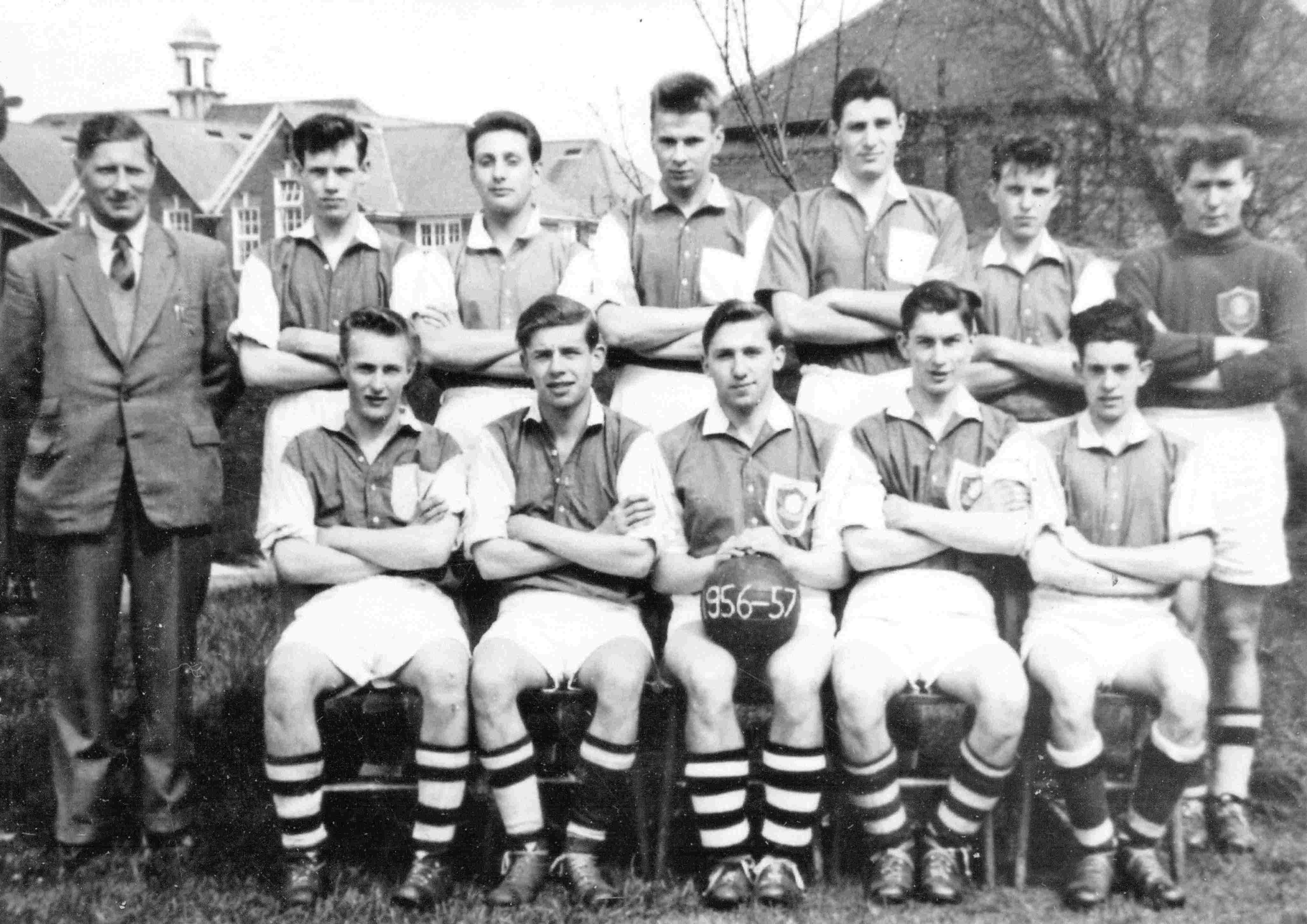
John Barry Dave Hendley Vernon Dover V. Holloway Rod Dale Murray Hawkesworth John Bowles
Bobby Owens ? Roy Gibson (Captain) Peter Frday? Robin Simmons
According to the Peveril magazine the following played for the 1st XI: R. Gibson (Captain), P. Harris (Vice Captain), J. Bowles (Vice Captain), V. Holloway, S. Bailey, C. Reynolds, R. Dale, V. Dover, D. Hendley, R. Simmons, M. Hawkesworth, P. Friday, E. Turner and R. Williams.
Teams they played were Itchen, Brockenhurst, Bishop’s Waltham, Basingstoke, Purbrook, St. Mary’s College, King Alfred’s College, Taunton’s, Andover, Southampton University and Old Bartonians. Results: played 15 matches won 7, lost 7 and drew 1.
As you can see we have been able to identify most of the players but If you can help fill in any of the blanks please let me know
.jbarron6@sky.com JCB"Complete" or "Finished"?
No dictionary has ever been able to define the difference between "complete" and
"finished." However, during a recent linguistic conference, held in London,
England, Samsundar Balgobin, a Guyanese linguist, was asked to make that very
distinction.
The question by a colleague in the erudite audience was this: "Some say there is
no difference between 'complete' and 'finished.' Please explain the difference
in a way that is easy to understand."
Mr. Balgobin's response: "When you marry the right woman, you are 'complete.' If
you marry the wrong woman, you are 'finished.’ And, if the right one catches you
with the wrong one, you are 'completely finished.'"
_________________________________
Here are a few further deep thoughts about our language……..not too deep I hope !………
Dearest creature in creation
Studying English pronunciation,
I will teach you in my verse
Sounds like corpse, corps, horse and worse.
In its fullest version, the poem runs through about 800 of the most vexing
spelling inconsistencies in English.
Attempting to spell in English is like playing one of those computer games
where, no matter what, you will lose eventually. If some evil mage has performed
vile magic on our tongue, he should be bunged into gaol for his nefarious goal
(and if you still need convincing of how inconsistent English pronunciation is,
just read that last sentence out loud). But no, our spelling came to be a
capricious mess for entirely human reasons.
The problem begins with the alphabet itself. Building a spelling system for
English using letters that come from Latin – despite the two languages not
sharing exactly the same set of sounds – is like building a playroom using an
IKEA office set. But from Tlingit to Czech, many other languages that sound
nothing like Latin do well enough with versions of the Latin alphabet.
So what happened with English? It’s a story of invasions, thefts, sloth,
caprice, mistakes, pride and the inexorable juggernaut of change. In its
broadest strokes, these problems come down to people – including you and me,
dear readers – being greedy, lazy and snobbish.
Invasion and theft………
First, the greed: invasion and theft. The Romans invaded Britain in the 1st
Century AD and brought their alphabet; in the 7th Century, the Angles and Saxons
took over, along with their language. Starting in the 9th Century, Vikings
occupied parts of England and brought some words (including they, displacing the
Old English hie). Then the Norman French conquered in 1066 – and replaced much
of the vocabulary with French, including words which over time became beef,
pork, invade, tongue and person.
The Norman conquest of Britain in 1066 - shown here in the 11th-Century Bayeux
Tapestry - introduced a number of French words into the language (Credit: GL
Archive/Alamy)
Once the English tossed out the French (but not their words) a few centuries
later, they started to acquire territories around the world – America,
Australia, Africa, India. With each new colony, Britain acquired words: hickory,
budgerigar, zebra, bungalow. The British also did business with everyone else
and took words as they went – something we call “borrowing,” even though the
words were kept. Our language is a museum of conquests.
What does this have to do with spelling? When we “borrow” words, they often come
from other Latin-alphabet spelling systems, but have sounds different from the
sounds we make in English. Many other languages, therefore, fully adapt words
they borrow: Norwegian turned chauffeur into sjåfør and Finnish turned strand
into ranta. In English, though, we wear our battle scars proudly. For some
words, we have adopted the pronunciation but modified the spelling: galosh (from
French galoche), strange (from French estrange). For others, we didn’t change
the spelling, but we did change the pronunciation: ratio (originally like
“ra-tsee-o” in Latin), sauna (the Finnish au is like “ow”), ski (in Norse, said
more like “she”). Or we kept the spelling and, to the extent reasonable, the
pronunciation too: corps, ballet, pizza, tortilla.
Lazy tongues…………
Adding to the greed is the laziness – or, as linguists call it, “economy of
effort”. Sounds tend to change to save effort for either the speaker (dropping
sounds out) or the listener (making sounds more distinct). Under Scandinavian
and French influence, we tossed out troublesome bits of the complex Old English
inflections, so a word like hopian got whittled down to hope, and over time, the
e on the end stopped being said. In more recent centuries, we have often kept
the spelling when sounds wear down: “vittle” is still written as victual. We
simplified some sound combinations – “kn” became “n” and “wr” became “r.” We
also stopped using – but not writing – some sounds altogether: the “kh” sound we
spelled gh got changed to “f” as in laughter or just dropped, as in daughter.
Sometimes sounds just change capriciously. The most significant instance of this
in English was the Great Vowel Shift. From the 1400s to about 1700, for reasons
that remain unclear, our long vowels all shifted in our mouths like cream
swirling slowly in a cup of tea. Before it, see rhymed with "eh"; boot was said
like “boat”; and out sounded like “oot.” But when the sounds shifted, the
spelling stayed behind.
Copper engraving after a late 16th-Century image of Dutch typesetters (Credit:
Alamy)
Tongues and ears aren’t the only lazy things. Scribes and typesetters can be,
too. If you bring over scribes from France or typesetters from the Netherlands
and Belgium, where the first presses in Britain came from, they will tend to the
standards they’re used to. The French scribes, with their Latin influence,
didn’t see why we would write cwen when obviously what they heard should be
spelled something like queen. The Dutch typesetters felt that gost was missing
something, so they slipped in an h to make ghost.
And, heck, if you charge by the letter, why not add in some extra e’s? They
seemed to be all over the place anyway.
And then came snobbery………
What really made sure that English spelling was a losing game, though, was
snobbery.
It started in the 11th Century, when French became the high-class language and
loaded up our culinary, legal and poetic vocabularies. But the snobbery kicked
into top gear in the Renaissance, when scholars developed a crush on the ancient
classics. They started borrowing words wholesale; many of our scientific and
technical terms come from Latin and Greek (and most of the Greek terms came
first through Latin, with Latin ideas of how to spell them). But they also
decided that words that we already had ought to display their classical
heritage, too. Does peple trace back to Latin populus? Then it ought to bear a
special amulet to show its nobility – let’s add the o and make it people! Det
owes a debt to debitum? Then put a b in so we know it! Many words had letters
added by this indi(c)table fau(l)t; sometimes, they changed their pronunciation
to match the spelling, as in fault. And sometimes the re-spellers were wrong
about the etymology. While isle (formerly ile) comes from insula (hence the s),
for example, island does not; it’s from Old English iegland.
During the Renaissance, English speakers started borrowing Latin and Greek words
wholesale - or changing words we already had to show their ancient heritage
(Credit: Alamy)
One more layer of snobbery has added further complications across the Atlantic
over the last couple of centuries: national pride. The (relatively few) American
simplifications of spelling – color for colour, center for centre – largely owe
their existence to Noah Webster’s desire to create a distinctive American
English. Canadian preference for keeping many British spellings, on the other
hand, has the same nationalistic origins… just in reverse.
And now? Now we don’t even want to spell things as they sound. How do spellings
like hed, hart, lafter, dotter, and det look to you? Uneducated, perhaps?
Annoyingly simplistic? Exactly. We enjoy our discomforts – and we really enjoy
arbitrary practices that allow us to tell who are and aren’t the “right sort”.
We’ve taken a useful tool and turned it into a social filter.
Greed started the problem of our language and laziness entrenched it, but
snobbishness lionizes it. The history of English is a tale of vice… and that is
a word, by the way, that we got from the French – even if we can’t blame them
for the vices themselves.
School Photos On Our Website:
www.bartonians.uni4m.co.uk by John BarronThe collection on the web site span the years 1919 to 1982 so there is every chance that you appear on at least one of them. We are trying to identify as many people as possible so please help. For those of you who do not have a computer I urge you to get down to your local library where a member of staff will be only too happy to show you how to get onto the website. Once you are on the website go to the bottom of the page and click on
School Photos. This will take you to the School Photographs page where the photos are listed. For example:1940
Photo Key Names Take a look at the Key and write down the names of anyone you recognise, and then check those names against the list under Names and let me know of anyone you have found whose name is not listed.Jane Page (Nash) with the help of former classmates, in particular Malcolm Clarke and Marion Dymar (Smith), recently identified everyone on the 1975 Upper 6th photo - 214 names in total! Shortly before her passing Biddy Cull was able to name over 30 pupils and staff in the 1927 school photo - not bad for a centenarian.
Please email me on
jbarron6@sky.com or write to 6 Lloyd Street, Crawcrook, Ryton, Tyne & Wear, NE40 4DJVeterans Hockey in the North East by John Barron
I have probably played more hockey in the past year than at anytime since taking up the game at school 53 years ago. I played my last game of the season yesterday evening (July 1st) for a North Shields / Tynedale team against St. Georges. It was a very close game which we won 4-3. On the pitch alongside, Sunderland/ Durham played Tynemouth. We then went back to the “Low Lights” pub in North Shield for a jar or two of real ale and some food, which the landlords provides free gratis because we are such good customers.
The summer veterans league is played on Wednesday evenings on two astro-pitches at a sports centre in North Shields and was set up by Mickey Christopher who plays for England LXs and single-handedly organises all veterans hockey played in the North East. There are at present only 5 teams in the summer league, those already mentioned and Gateshead. Morpeth dropped out last year because they did not have enough senior players (over 35 yrs), which was no problem really because their older players were soon absorbed into the other teams.
There is no veterans winter league in the North East so those veterans who choose to play in the winter will be in the hockey development league, where you will find oldies like me and lots of youngsters. I play for Tynedale 2s in Hexham where I rub shoulders with 14 year olds. I often umpire for our 1st XI or the ladies team on Saturdays as well, so I am kept busy. Then there is coaching the youngsters on a Sunday morning of course.
There is the North of England Masters Hockey Association which enters over 60, 65 and 70 teams in the national hockey tournament which is held at Cannock in May. Those wishing to take part attend trials in Sheffield, Manchester, Carlisle and Norton. I was disappointed in not getting into the over 60s team but competition was stiff.
However, Cumbria, Northumberland, Tyne & Wear and County Durham join together to form a “Border Reivers” team (the Border Reivers were lawless families who plagued the region north of Hadrian’s Wall a few hundred years ago, stealing cattle and, I expect, raping and pillaging as well) which plays in a national county cup competition. I have played a number of games for them against Derbyshire and Staffordshire.
This is sub-divided into a North East vets team , also called the Reivers, and I have played for them against Cumbria and England Grand Masters (over 70s). In June we went to Cockermouth to play against an England LX (and older) team as part of their weekend of trials. They fielded 3 teams and various veterans teams in the region had been invited to give them some opposition. We won our game 4-1 but to be fair we were fresh and they had already played several games that weekend and had, I am reliably informed, consumed several pints of Cumberland Ale the night before. There were at least two over 75s on the pitch!
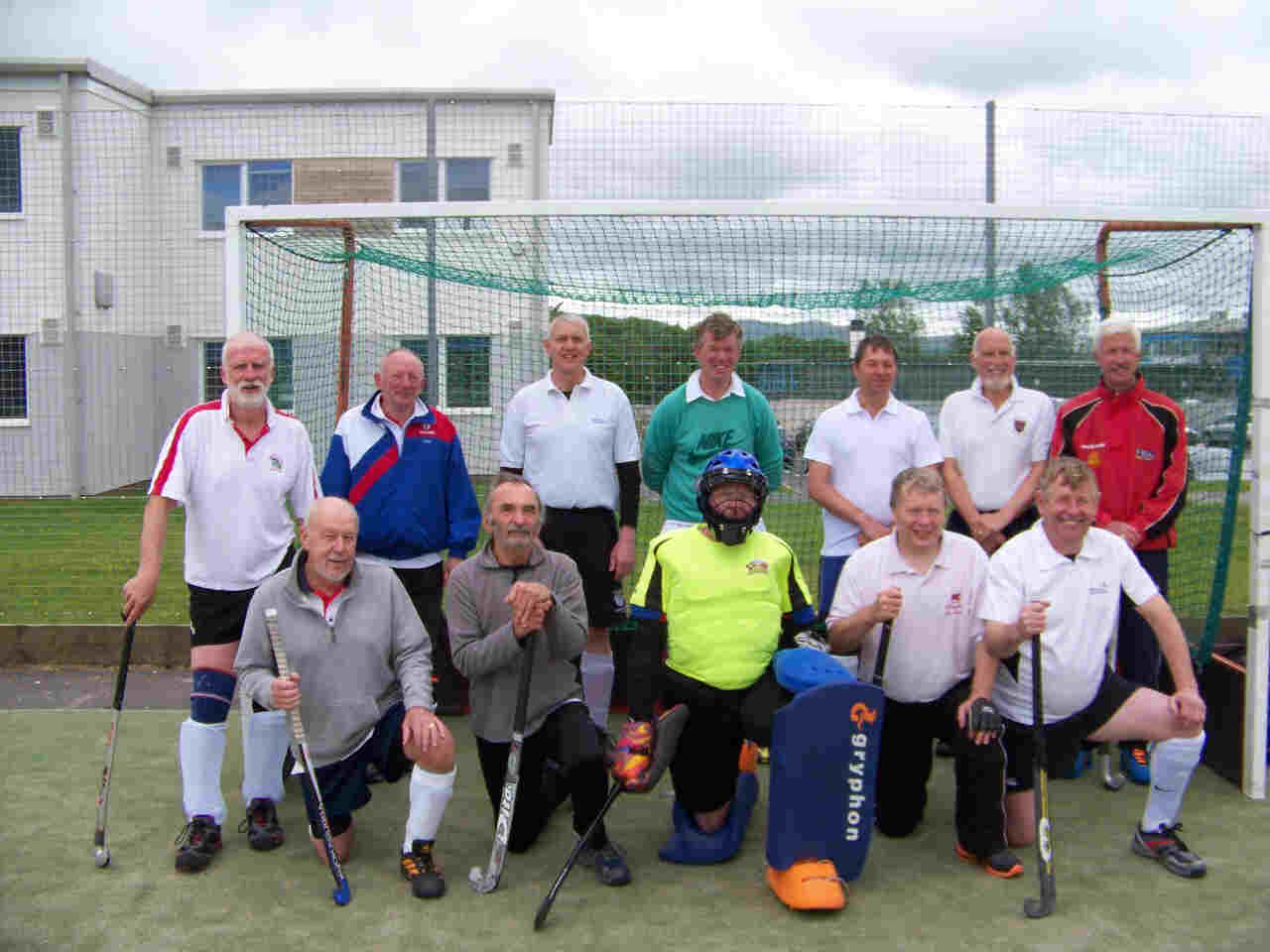
Reivers at Cockermouth in June.
The Pallatics Logo
In April I was invited to join the Pallatics and we went to Bowness on Windermere for a weekend and played matches against the Lakelanders, North Lakes and Morecombe. Set up in 1981 by Mickey Christopher as a touring team, it is now a predominately veterans team. Last year they went to Gibraltar and in September they are going to the Channel Islands. The term Pallatics is the North Eastern equivalent of paralytic and was, I believe, frequently used by the cartoon character Andy Cap whose logo appears on our shirt. The choice of name is no coincidence!
It seems a lifetime ago when I first walked onto the grass hockey pitch at Barton Peveril proudly holding my English-head stick to be told by games master John Barry “You’ll never play hockey with that Barron!”
In this Issue my thanks go to John Barron, Michael Arnold, Henry Lassiter (USA correspondent), Jonathan Prest and Carolyn Rogers for their contributions.