
THE BARTONIAN
www.bartonians.uni4m.co.uk


-------------------------------------------------------------------------------------------------------------------------
Issue No. 58 Summer 2017
********************************************************************************
The Magazine for ex-pupils of Eastleigh County High School & Barton Peveril
********************************************************************************
Editorial Comment:
Most of you would have heard by now that a number of our members have sadly passed away this year- see “Acting Chairman’s Report” below. They include Cecil Churcher, who was our Chairman for nearly 20 years, and John Adams, who served on the Committee for almost as long. Cecil was already 70 years of age when he took on the role of Chairman when the Old Bartonians’ Association was re-launched in 1997. Our thanks go to both of them for their valuable service to our association over many years.
Both Cecil and John, of course, were members of the Old Bartonians’ Football Club which, according to Frank Rogers “ … came into being in 1939. Unfortunately the outbreak of war brought its activities to a sudden and premature end. The Club remained in abeyance until 1947 when it was reconstructed, again largely through Reg Cannon’s efforts. He could truly claim to be the founder and inspiration of the Club.” The team had great success in the 1950s, winning a number of trophies including the Southampton Senior Cup in 1953; the final against the Southampton Gas Employees, was played at The Dell. It folded in the 1960s when the supply of players dried up, as more and more school leavers left the area, either to go to university or to find work. It held its first reunion in 1985. It is not surprising then, that it was the ex members of the OBFC who formed the nucleus of the present day OBA.
Once again we had a very enjoyable dinner at the Red Carpet Restaurant at Eastleigh College in May and at only £20 per head, absolutely amazing value for money. At the AGM the following day we elected a new Chairperson, Sue Davenport. After that splendid tea which Sue, Lorraine and Debbie had laid on, was the result of the election ever in doubt? We wish Sue every success.
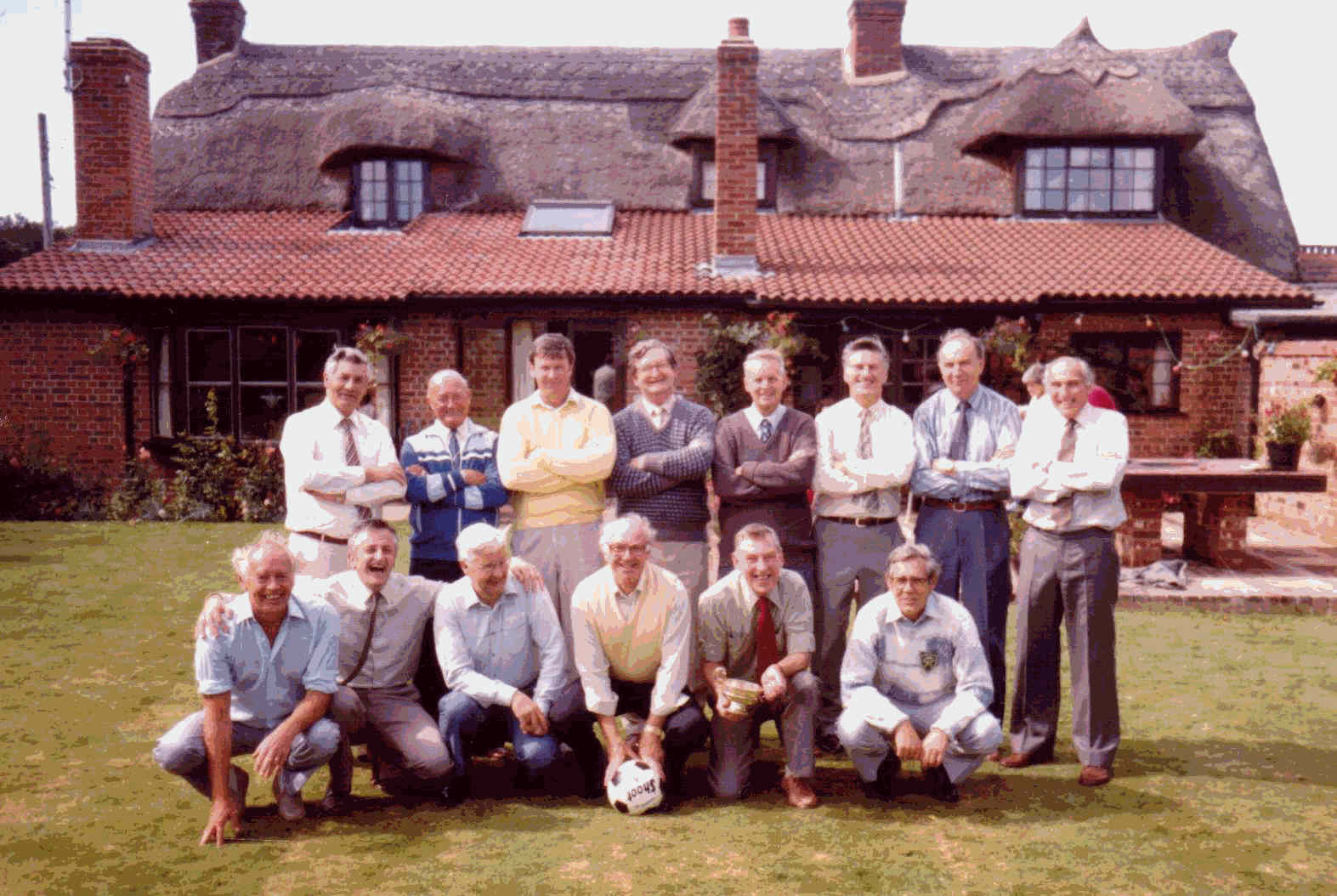
Ex members of the Old Bartonians’ Football Club at their first reunion in 1985 Do you recognise anyone?
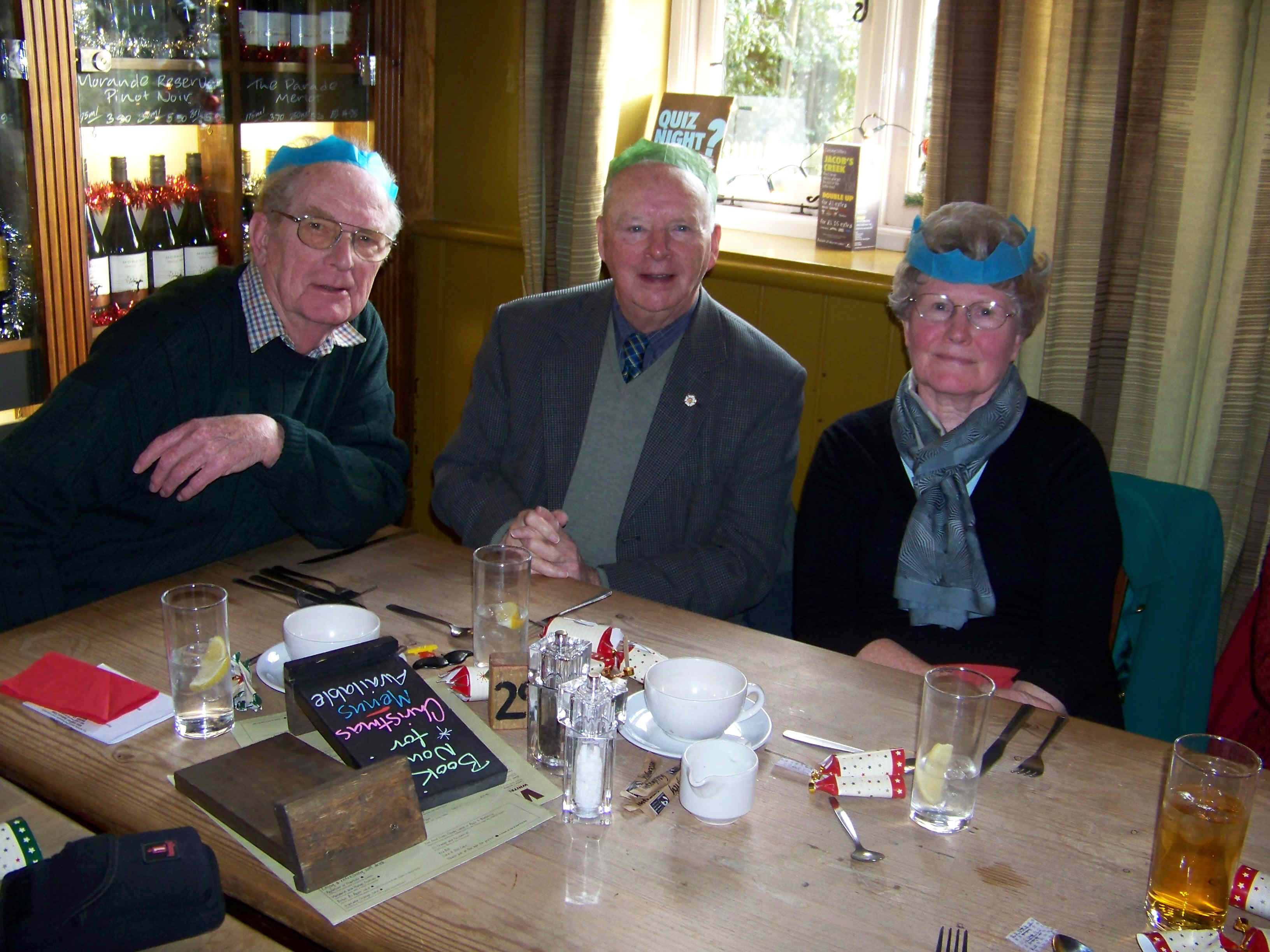
Cecil Churcher (centre) and John & Joy Adams at the Cricketers Arms, Christmas 2009
Sue Davenport (neé Chisholm) 1962-1967

Ladies and Gentlemen,
I must thank you for the confidence shown in me to be elected Chairperson. It is a great honour and pleasure to represent you in this way.
During the last year we have lost a few more members, in particular, Cecil Churcher (our previous chairman and stalwart of many years), also another committee member, John Adams.
In these increasingly uncertain times, it is good to reflect on the past events and circumstances that have shaped our lives. For instance, my own time spent at Barton Peveril, I now recognise, had a massive impact on the person I have become and regard it important to recall these issues.
It is pleasing to see that we are attracting new committee members to hopefully continue the aims and objectives of the Old Bartonians.
The life blood of the committee is our newsletter and may I encourage everyone to share their thoughts and reflections by submitting ‘whatever’ for publication, to enable the Bartonian to continue.
_______________________________________________
Does anyone have knowledge of whereabouts/contact details for the following ex pupils from the late 60’s – Phil Hanna or Will Durrant? This request comes from Marion Shaw (neé Ince) who did not attend BP but knew Phil and Will socially. ………Ed
Barton Peveril College Today
It has been a year of awards for the College and our staff. Barton Peveril has won a clutch of national and regional prizes this year which present a picture of life at College and our priorities.
The College and our landscape architects have been nominated for an award for the development of the courtyards over the past three years. The organisation is the ‘Landscape Institute’ and the category ‘Adding Value Through Landscape’. As the College has grown in size we have wanted to preserve the reputation for being friendly, supportive and welcoming. When it came to designing the Nobel and Science Centre we deliberately built them around a courtyard to create spaces for recreation and to provide outdoor learning opportunities. We wanted to recreate the monastic or Oxbridge concept of the ‘Quad’, a place which allows all people in an organisation to meet and interact across the disciplines. College courtyards have been designed to allow students to sit on walls, steps or benches, and in clusters to take pressure off indoor social spaces. Photography students, in particular, have made use of the space for their work.
In February, the Head of Humanities reached the shortlist of the Times Education Supplement teaching awards and he and some of his colleagues attended a celebratory dinner in London. Mark Robinson’s initiative has been to use a new IT application called ‘Google Classroom’ to enhance and organise the learning of humanities students. All the materials are stored in the cloud and students can see what is coming up on their courses, find reading materials, tests, essays and so forth, and then use them to enhance their learning. Students are able to work on a joint project with other students, each in their own home. Teachers can tell who has read what source or background material and can see if students have started their essays, allowing them to chase students before the deadline rather than after it! Mark’s pioneering work has meant the College is a ‘Google Lighthouse’ centre of excellence and innovation, and his lead has stimulated many other teaching departments to follow suit.
In June, the Sixth Form Colleges’ Association introduced a series of national awards for the 90 colleges in the country. Barton Peveril was only one to receive a first prize and a nomination in another category. Our first prize was for the support we offer students. It reflects the culture of support which prevails in all aspects of college but singled out was the initiative of the College Counsellor and College Nurse, together with a teacher of Psychology, to set up an academic counselling training course for students who become peer mentors in their second year. It is an ingenious way of furthering students’ skills and learning whilst also addressing the mental health needs of some of the students.
Individual members of staff with very different responsibilities were recognised in The Daily Echo Education Awards this year. Jack Brown is a Maths teacher who has become a phenomenon on the web for the videos he has made to help students approach some of the more challenging aspects of A level maths. Students can get on the bus looking at their phones, learning the finer points of calculus. Meanwhile, in the Nobel Café below the Maths department, Lisa Marsh serves students their coffees and as she does so acts as an agony aunt, confidant, and friend. Lisa has been awarded support staff of the year.
Helen Wheelwright set up a German day in College for students studying GCSE German in local schools to encourage them to continue their languages into the sixth form. The event was organised with the Goethe Institute. Following a successful day, she was nominated for the Goethe prize by the College and attended a reception at the German Embassy, where the special guest was John Le Carré.
Finally, Alix Christopher, a teacher in the Sports department has been nominated for a national diversity award for promoting sports opportunities to under-represented groups. The outcome will be announced next term.
Thank you for your continued interest and support of the College: I hope you are reassured that we continue to offer an excellent education for young people and support some of the values which build and preserve the best features of our community.
Jonathan Prest
18 July 2017
_______________________________________________
AGM 6th May 2017
Acting Chairman’s Report
We are slowly shrinking as an Association. I am expecting fewer here today than in previous years, and we had reduced numbers for the Dinner last night.. We have received a few apologies, most quoting illness in themselves or their partner as a reason for not travelling. I regret to report a few Old Bartonians that have passed on: Cecil Churcher, John Adams, Len Purchase, Thelma Davidson, and lastly Josie Collins, who had not been an active member for a while.
Today we will be presenting the College with the Churcher Cup, to remember the contribution Cecil made to the regeneration and continuing life of the Association.
We continue in our attempts to keep all Old Bartonians’ in touch with each other and to enjoy a number of social events throughout the year. John Barron has taken over as the Editor of the Bartonian and is doing a splendid job on continuing Cecil’s work. He does need articles for publication so that we can keep the magazine going.
Jonathan Prest will provide us with detail of how is pupils continue to benefit from our Bursary scheme. This item remains popular with members, and we do get an idea of how we are thus able to assist pupils extend their education. We will repeat this for as long as our finances allow.
Two Dinners and two Quiz Nights over the last year, with the Quiz Nights even more popular, getting close to filling our usual venue. Reunion day, today, remains popular and we are grateful to be allowed to use the facilities of Barton Peveril College.
This year is our 20th Anniversary. We have not planned any special events, but note it as an important milestone. Today we hope to elect a new Chairman, and look forward to how we can continue to run the Association best for our members.
My thanks go to fellow Committee members, particularly our Secretary Lorraine and quizmaster Chris, for their time and efforts in seeing us through another year.
Geoff Chadwick
Acting Chairman

Geoff Chadwick presenting the Churcher Cup to Jonathan Prest
Treasurer’s Report
This Report covers the period from 1st April 2016 to 31st March 2017.
Membership: We are very much down on renewals this year by today’s AGM, which may be due a lot to the forms going out by email as well as normal mail. Reminders are being sent out. Once more many members have apologised for being unable to attend this AGM but pass on their best wishes.
Accounts: We retain a healthy bank balance; today at £4,912, though we did have a small loss in the accounting year. Online banking is working well, but still presents me with a small challenge when balancing the accounts for I can match my payments to the year end, but no longer control when the money goes in. We continue to make a good profit from the Quiz Nights, for which thanks are to Chris Owen, and our two Dinners are kept close to the actual cost. Our subscription covers the major outgoings and the overall margin remains steady. Printing costs have reduced with a change of printer and smaller magazines, though other costs, such as for the office expenses rose a little this year.
Donation: Again we were able to give £1000 to the College for bursaries to support students in community projects and we still intend to repeat that each year. We will again be told of how that money was spent. Please continue with your generosity, if and how you are able.
College: We continue to receive excellent support from the College, being provided with facilities for meetings and this AGM free-of-charge, with office support throughout the year. We also benefit from free banking from HSBC, with the addition of online banking, and the time and attention of the Committee members.
Overall: Our finances remain healthy. I hope that you will continue to support and enjoy this weekend and other social events during the year and encourage old school friends to join (or rejoin).
Geoff Chadwick
Honorary Treasurer
Our thanks go to Geoff for all his hard work … Ed
_______________________________________________
Since the AGM we have learnt that David Jeffries has also passed away. David and his wife Margaret regularly attended the OBA AGMs and Annual Dinners. Ed
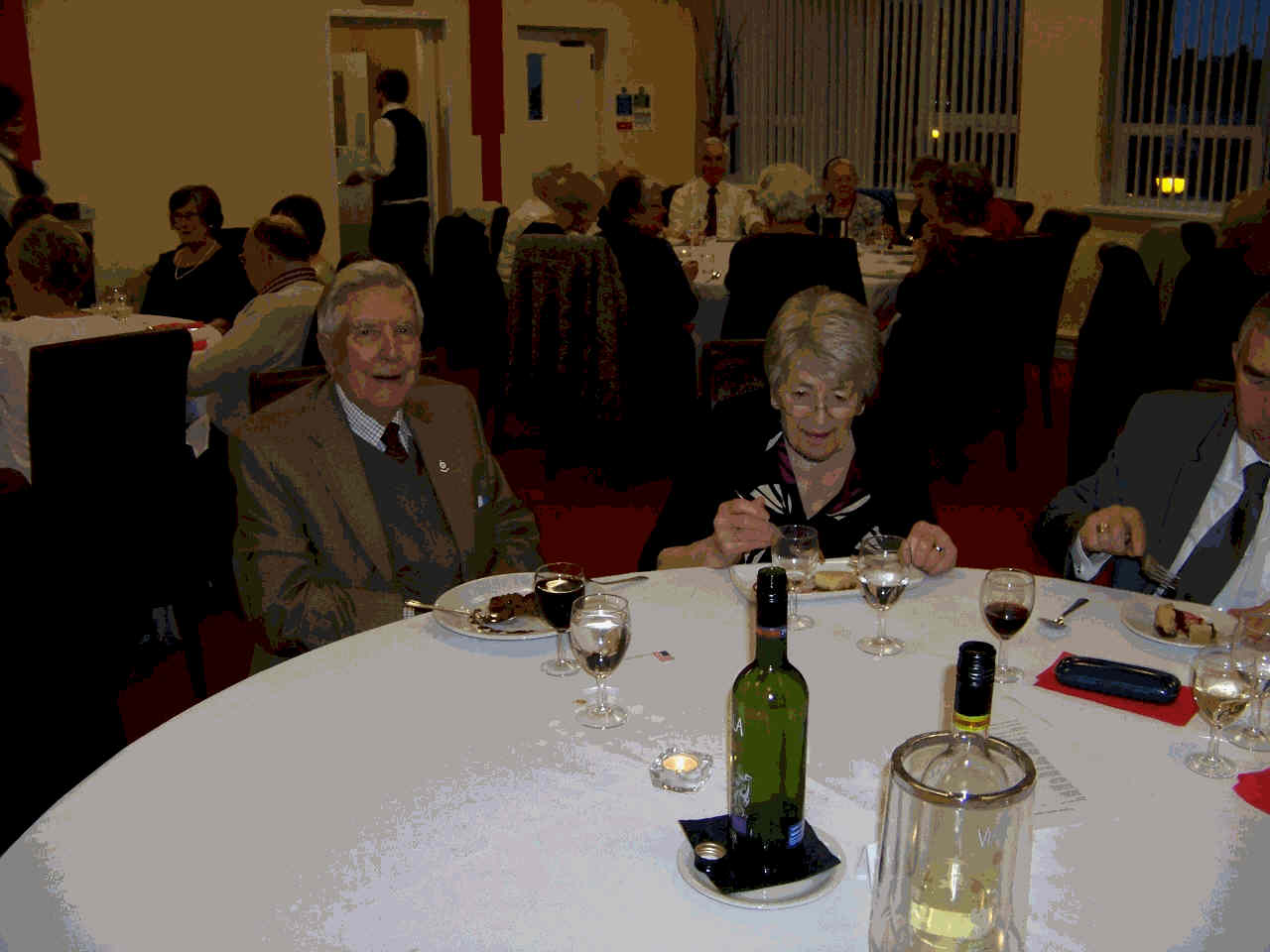
David and Margaret Jeffries at the Red Carpet Restaurant in May 2013
The following letter was received from Cynthia Ward (neé Marsh) 1949-56
I very much appreciate all the efforts made to keep the Association going. Distance (and in the past, family commitments) prevents me from attending events, but I do appreciate the newsletter.
Apart, however, from that dreadful article by Michael Arnold! No wonder it was published in the USA: I’m sure the Ausies would not have touched it. Or - was it a cunning ruse on your behalf to encourage members to put pen to paper? Well, if so, that worked - and so I’m sending you a few of my school memories. I hope you can read them: my husband was the computer man - I prefer to be old-fashioned!
I attended Eastleigh County High School … As an only child, I loved the companionship and the intellectual challenges. For various reasons, I did not go to university at the conventional time - but became a (very) mature student and graduated in 1996 from Nottingham University with a 1st Class Honours Degree - Archaeology.
I am still in contact with friends from school - then known as Audrey Knowles, Monica Gilbert, and Doris Butler: all of us now sadly widows.
Memories
1) Yes. Mr Sansbury - and those splendid Geography excursions to the Isle of Purbeck, Corfe Castle and the Earlywarm Blanket at Witney. I still have the photographs of them - what a great photographer he was. And learning about the start of a settlement - first came the church and then an inn - described by him as “ the thirst after religion” and hence never forgotten!
2) Freezing cold damp on the hockey field: we had to wear only PE shirts - no sweaters of any kind!
3) A marvellous English teacher called “Mrs Welby” - I think she was also Senior Mistress at the time. Her love of Shakespeare inspired her to organise trips to the Old Vic Theatre - London - to see productions - at that time they were doing all the First Folio plays. The famous production of “Romeo and Juliet” with Claire Bloom as Juliet and “Hamlet” with Richard Burton. I shall be forever grateful to her - I have done “Am. Dram.” ever since - and one of my sons is a Drama teacher.
4) French with Gordon Cox: well, I can still help my grandchildren with their GCSEs!
5) Maths with “Chippie” Wood - I now realise he must have been an N.Q.T. - but he could really teach and explain things (not a natural mathematician I ended up enjoying it - and getting an ‘A’ at ‘O’ level!)
6) The ‘Country Dancing’ after-school class which I helped to run. Well, at nearly 79, I am still enjoying English and Scottish Dancing!
7) Does anyone else remember the ‘Schools Pageant’ put on by all Eastleigh Schools - Coronation Year? Yes I have photos of that too. Mr Sansbury again?
So - ECHS did affect the rest of my life and I will forever be grateful.
Was this the photo you mention Cynthia, which came from David Lowton? Ed
“Invitation to the Dance” Eastleigh Schools’ Pageant 1953
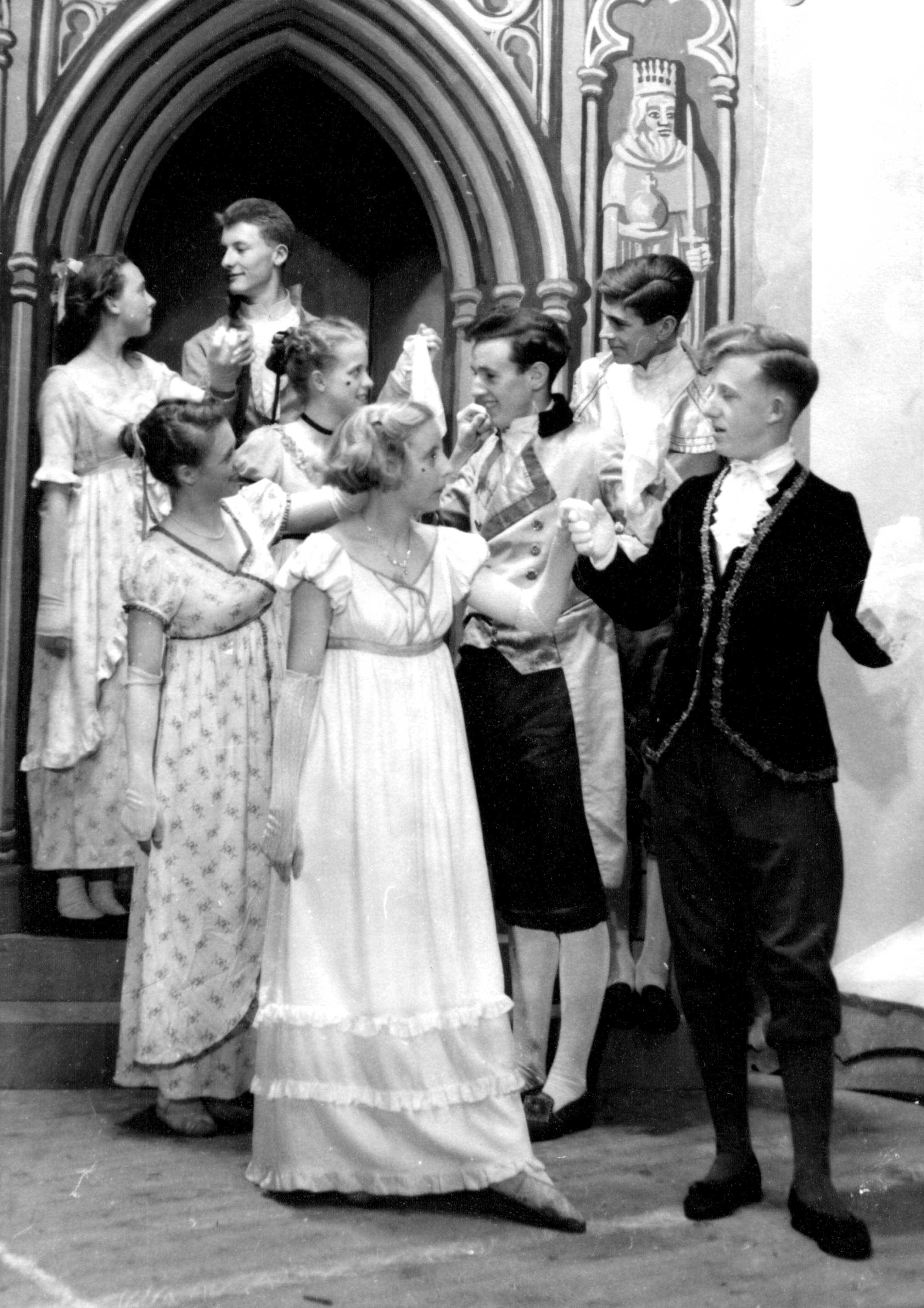
Audrey Knowles Willie Francis
Cynthia Marsh David Lowton
Mary Masters John Veck
Monica Geary J. MacDougall
After speaking on the telephone to Cynthia, having persuaded her to let me include her comments about Michael Arnold’s article, as in my opinion he would more likely be flattered than offended, I got back down to preparing the newsletter. A few minutes later the telephone rang, and a lady whose voice I did not recognise, said that she had dialled 1471 and our number had come up. The conversation continued something like this: “Did you want to speak to Barbara Barron perhaps?” “Ah, yes. I expect she was ringing to thank me for the birthday present I sent her.” (I was a bit puzzled because my wife Barbara’s birthday is in February!) “Well, she’s not in at the moment, who shall I say called?” It’s Margaret, I’m her sister-in-law, she’s married to my brother Roy.” “What! But, I’m married to Barbara!“ For a brief moment I thought I must have slipped into a parallel universe. However, in the end it transpired that we were talking about two different Barbara Barrons - or has my wife has been leading a double life!
It turns out that her telephone number is only one digit different from Cynthia’s. I am fairly sure that I had dialled the number right the first time but who knows? So what are the chances of this coincidence happening: a million to one? Perhaps I should buy a Lottery ticket!
Not to disappoint you Cynthia - here is the second part of Michael’s article … Ed
_______________________________________________
Michael Arnold 1945-53
The following is the second part of the chapter that appeared in the last issue of The Bartonian. Unsurprisingly perhaps the book was far more successful in the United States than in Britain, in fact one British reviewer going so far as to say that he was amazed to discover that Michael Arnold was English! Even in the face of documented facts we still cling nostalgically to our myths - perhaps they make us feel better - and any questioning of the conventional account is almost viewed as treason.
Hollow Heroes - Introduction - An Unholy Trinity - Part Two
Montgomery’s prestige and renown was procured very largely by self-contrived propaganda and embellished by a British media desperate to produce encouraging news for an eager public at home. When Corelli Barnett’s book was first published in 1960, it provoked a considerable amount of irritation, typified by the blustering indignation of Lord Randolph Churchill in the News of the World, who commented condescendingly about ‘the sergeant who dares to criticise field-marshals’, leading one to ponder whether the concept of a mere sergeant having education and intellect was so impossible for him to stomach. Barnett had been in the Intelligence Corps whereas Randolph Churchill’s reputation was such that when a few years earlier he’d had a growth removed, the event prompted Evelyn Waugh to comment succinctly, ‘It was a typical triumph of modern science to find the one part of Randolph which was not malignant and remove it’.
Attitudes had changed by the time the Second Edition of The Desert Generals was published. In 1983 Corelli Barnett commented: ‘Montgomery was by then reduced to life-size, a Plumer rather than a Wellington, and an eccentric rather than a genius’
Since that time there has been an increasing acceptance that the received view during the glowing years immediately after World War Two had largely been coloured by what Montgomery had said himself - and mostly about himself - and the need to perpetuate the conventional image of a military hero in a war recently won; the same went for Churchill and Mountbatten. The British press had quite naturally championed them all and were most receptive to their frequent press conferences, especially since whatever the truth, they always produced good news. During the anxieties of War, the people of Britain had needed champions on which to hang their hopes and Churchill, Montgomery and Mountbatten provided convenient and immediate images for encouragement and admiration. Cooler, more measured and less emotional analysis has recently produced rather different conclusions, a question of longer perspectives in time enabling greater impartiality and refined assessments.
In World War Two all three of these men were indifferent to casualties in pursuing their own agendas although only Churchill and Mountbatten overtly so. Clive Ponting makes a specific point of this in his book where he records that in 1943 Churchill had even made the remarkable complaint that British casualties were not high enough [i]. Mountbatten was indifferent and totally unrepentant about deaths caused directly by his own irresponsible actions as a destroyer captain and quite insouciant of the enormous losses suffered as a result of his direction of the disastrous 1942 raid on Dieppe. In 1945 and as already mentioned, he had insisted on going ahead with the planned but quite unnecessary invasion of Malaya. The official details of which even now are still kept concealed.
In similar fashion and to bolster his image and indifference to casualties, Montgomery would direct operations that were unnecessary, such as the Second Battle of El Alamein which he claimed as his own triumph and then the huge civilian casualties he inflicted in his dithering efforts to take the French city of Caen in 1944 and the debacle at Arnhem, which despite being his own invention, he claimed wasn’t his fault. He then topped all these off by distortedly claiming he had almost single-handedly saved the Americans during the German Battle of the Bulge in December 1944/January 1945, causing perfectly justified resentment amongst the Americans without whose generosity the war could not have been won.
The plaudits for Montgomery seem to have been almost exclusively British for I have been unable to locate any author, American or German, who had such a high opinion of him. There is plenty of praise from the German side for Patton, Wavell and Auchinleck for instance or from Britain and America about Rommel, Guderian and Manstein, but there does not appear to be any American or German acclaim for Montgomery; this is a fact that surely speaks for itself. Certainly there are comments about him from outside Britain but in every case they are only descriptive of a carefully planned but cautious style. Apart from what Montgomery claimed himself (about himself) it appears his reputation rests on the fact that there was an understandable public need in Britain to find a hero that the nation could celebrate. The sad truth is that as mentioned, Churchill sacked two of his finest generals Wavell and Auchinleck, but otherwise there were very few and whereas there is now broad acceptance that Slim was Britain’s outstanding military leader of World War Two, he was stationed far away in Burma and was not the colourful sort of personality that could be so easily promoted.
Churchill’s reputation preceded the Second World War by some twenty five years when he was a very young First Lord of the Admiralty. This started with his being implicated in the forced resignation of Mountbatten’s father, Prince Louis of Battenberg as First Sea Lord in 1914 and continued as the prime mover of the ill-conceived and disastrous Dardanelles campaign of 1915 which forced his own resignation. Churchill may have had some twinge of conscience about his unjust but politically convenient removal of Prince Louis so perhaps he tried to balance his guilt through undue patronage of his son.
In the closing chapter of his book, ‘Churchill, The Struggle for Survival’ [ii], Lord Moran assessed Churchill’s image prior to 1940:
‘No doubt the eccentricity of his judgment contributed to the lack of confidence of his countrymen. They were bewildered; they did not know what he might do next. They found him quite unaccountable, in a measure irresponsible. It is the tale of a preacher without a text. The fact is that Winston’s story before the war is the chronicle of a self-centred man making his plans in order to win personal renown. In the House of Commons he had few friends. No party wanted him. If he had died before the war he would have been accounted a brilliant failure’.
The problem was that leopards don’t change their spots – they can’t. Once Churchill had gained power, those around him and who had to work with him, still didn’t know what he might do next and found him unaccountable; nothing had changed but the circumstances. The fundamental personality characteristics observed by Lord Moran - self-centred, unaccountable and irresponsible - were not likely to disappear overnight and they didn’t. The war gave the preacher his text, but beyond his inspiring rhetoric in the early days of the war when he was word perfect Churchill was frequently disturbing because the eccentricity of judgment that Moran had noted was to appear time and time again.
The science of psychological profiling was not developed by the FBI until the 1960s and has subsequently proved a valuable tool in solving crimes by enabling an image of the perpetrator to be produced. Whilst not suggesting that Churchill was a criminal his own psychological profile, based on the singular characteristics identified by Moran – self- centred, unaccountable and eccentricity of judgement - would seem to indicate a personality that should never have been allowed to have total control, and yet apparently without opposition or question that was precisely what Churchill made sure he did have. As was to be proved, total power in the hands of such a personality was extremely dangerous.
Moran’s book caused something of a controversy, appearing as it did only a year after Churchill’s death, and many of his insightful but subsequently accepted views were widely and angrily resented and refuted. However, at the time of his appointment as Churchill’s personal physician in 1940 he was already 58 years of age and had a longstanding and very successful private practice. It is reasonable to assume therefore that the personality traits he said he had observed and noted were based on measured and experienced diagnosis.
Mountbatten’s name first came to public attention through the overt philandering of his very wealthy wife, Edwina, but his reputation really only started with the War. It continued afterwards with his rushed handling of Indian Independence in 1947 the legacy of which is now seen almost every day in the conflicting religious, ethnic, cultural and geographical complexities involving India and Pakistan. The British Government had hoped that this very difficult task might be achieved in perhaps 14 months although even that length of time was thought to be optimistic. In the event Mountbatten hurried the whole complex exercise through in a quarter of that time, 14 weeks. To handle the incredibly sensitive establishment of new national boundaries, Mountbatten imported for just three weeks a previously unknown boundary drawer, a man who had never before set foot anywhere in Asia let alone India.
Montgomery spent a large amount of his time in the years after World War Two satisfying his ongoing craving for fame and glory by criticising the Americans, who had suffered his arrogance during the War with quite remarkable patience, and by writing books telling everyone how he’d won the War. In the many books that have appeared on each of Churchill, Montgomery and Mountbatten these facts have sometimes been mentioned only en passant and in others overlooked or deliberately omitted.
It is not the intention of this book to denigrate the three of them completely, for without doubt there were achievements, nor is it the type of revisionism written by people who seem to specialise in unproven rumour and conspiracy theories. Such books of course tend to attract attention simply because their allegations are in many cases impossible to disprove and as the saying goes if you throw enough mud some of it will stick. What is quoted here is either fact, or where it is an opinion, it is quoted from an unearthed factually based authoritative source. Certainly questions are raised, but when unexplained anomalies are uncovered then surely it is only right and logical that they should be questioned. To such a degree was truth a wartime casualty that fifty years ago much of what is written here would have been dismissed as fiction or regarded as heresy. Facts, however, have an uncomfortable habit of leaking out and some balloons should occasionally be deflated.
Facts are sometimes uncomfortable, unpalatable or unwelcome, especially when they demonstrate that a previously held belief is open to a different interpretation or that in truth a hero had feet of clay. But that sometimes is life and if uncovered facts lead to a re-think or some speculation that also, sometimes, is the way of life. It is what is often termed ‘cognitive dissonance’, a reluctance to accept what is unwelcome. I have quoted widely from the recent – but not necessarily revisionist – authors already mentioned and of course Correlli Barnett, that most analytical, impartial and seemingly inexhaustible writer of military history. For the sake of those who needlessly suffered or lost their lives specifically because of the excesses and contrivances of the individuals mentioned here, a balance should be provided and the record put straight. I hope this book might go some way to achieving that aim.
[i]
Ponting, Clive, Churchill, Sinclair-Stevenson, 1994[ii]
Moran, 1st Baron, Churchill, The Struggle for Survival, Constable 1966
_______________________________________________
School Photos
None of us is getting any younger and memories fade, so please take a look, or another look as the case may be, at your school photo/s. There is no excuse, as our website is now easily accessible on a range of equipment - Pcs, Laptops, Tablets and Smart Phones. Anyone over the age of about 3 years will be able to help you.
Our website address is:
www.bartonians.uni4m.co.uk This will take you to our title page. At the foot of the page you will see School Photos in big red letters. Double click on this link and it will take you to the photos page, where the school photos are listed in chronological order eg.1978 Photo Key Names
The simplest approach would be to go to the Key first and write down the name and number of anyone you recognise and then check to see if they are listed under Names. If they are not listed then please email their details to me on jbarron6@sky.com.
_______________________________________________
Most of the correspondence I receive is by email; the senders often prompted by the discovery of the school photos on the website. The following are edited versions of some of emails which I have received since publication of the last newsletter. I have not included all the lists of names. Ed
Hilary Edwards (neé Harvey) 1964-
Thrilled to discover the website with the photos, re: September 1967 (I still have a copy of this)
I am no 86 on the far right hand end - they perched me on the very end as I was small
my name then was Hilary Harvey (1964)
305 - Joy Rideout - definitely sure about her as she was a friend (1964) , 308 - Frances (Frankie) Cougill (1964) , 540 - Letitia Dean - remember she was in a wheelchair (started later than 1964 I think) , 488 - Claire Dalley (90% certain) , 603 - Kerry ? (started later) , 286 - Pamela Waller (1964), 288 - Beverley Gates (cousin of Pam)(1964) , 315/548 - Dagmar Scholes - definitely 315 (1964) , 299 - Penny ?
I will be looking again at the photo and will hopefully be able to give you more names.
Regards, Hilary Edwards (nee Harvey)
_______________________________________________
Kelley Beeston (neé Pritchett) 1968-
Hello John, Can I just say how absolutely delighted I was to discover the one and only school photo that included me online. Sadly my parents couldn’t afford to purchase the photo at the time, which I have regretted immensely in subsequent years, so just imagine my delight when I found it - I’m just trying to work out how on earth I can get a printed copy. Fortunately my children’s situation was better than mine and the 3 of them each have a framed photograph of their school years which both I and they cherish. I am an ardent genealogist and actually visited Eastleigh for the first time in 40 years last weekend in search of my childhood. It was an incredibly emotional experience - so many things had changed and yet so many things were still recognisable. Sadly as I pulled up to the two old entrances to the school and the new one in Chestnut Avenue I was not able to recognise ‘my old school’ at all. So I didn’t take any photographs as it just was not recognisable - the only things that were recognisable was one of the trees (which was out of bounds, on the school perimeter) where some of us used to meet to sneak over the fence at lunchtime - naughty yes, but we never got caught!!
So, my reason for getting in touch is that I am able to name a few faces on the 1971 year 1,2,3 photo and confirm a couple where you have question marks. There are also a couple of people who seem to be missing from the photo - I’ve searched and searched but can not find them - maybe they weren’t in school that day? One is Angela Saunders who would have been Yr 2 - she was and still is one of my best friends, so I shall have to send her all the info as she may be able to identify herself and some more missing people in Yr 2. The other is Heather Meehan Yr 3 ( she had a younger sister Rachel Yr 2 who I can’t find either). Sadly Heather was killed in a motorcycle accident (before crash helmets were compulsory) and it was most probably around this time, which might explain both their absences or I‘m just not recognising? I’m Yr 3 - the sulky looking girl no. 79 - can I ask you please to amend the spelling of my first name Kelly to Kelley (quirk of my parents!!! ) It’s so funny as I still pull the same face today but try really hard not to !!!!
I can confirm a couple of question marks: 284 - yes - Paul Gambling , 392 - yes - Andrew Cushion .
I can confirm: 81 - Alison Horton
XX - XXX- [ number and name removed ] I’m pretty sure this is XXX but my strong memories of her are later than this photo - it’s a really really sad story - she was my best friend and was extremely suddenly expelled for being pregnant - which to me was totally inexplicable and totally out of character. I never understood what happened at the time nor the years that followed after she was expelled. Overnight she was taken into care and my parents were very supportive and took me to visit her in various homes and later in mental institutions. It is only in recent years that I have begun to piece together the bits and pieces and begun to understand what probably happened. I now understand that she self harmed and I suspect she was a victim of chid abuse. Sadly the education system at that time did nothing to protect or support her, knowing what happened in the aftermath of her expulsion … (I did get Kelley’s permission to publish this)
129 - Linda Fletcher, 290 - Kathryn (Katherine?) Fitzgerald , 323 - Susan Collins , 354 - Diane Davis/Davies , 361 - Christine ?Hughes - can"t remember her surname for definite, good friend of Jennifer Matters daughter of teacher Mrs Doreen Matters PE .
Possibles: 141 - ? Georgina Pugh , 167 Julia?? - pretty sure this is her first name
Amendments: 195 - is a girl not Bruce Tarran is he 194? , 249 - is a girl - should it be Julia rather than Julian???? , 270 - is a boy not Julia Powell - possuibly someone nearby on the photo?
I also have video somewhere of the Tchiertchen 1971 ski trip - will go on a rummage but it was film footage that Mr Whitfield took on my grandfather’s cine camera - so it’s stuff you probably already have. Thanks so much for making this possible Kelley Beeston (Pritchett)
_______________________________________________
Alan Young 1960-1965
Hello John, My brother Malcolm told me about these pictures in the week and sent me a link to view them.
As soon as I saw your name on the header I remembered a blonde haired kid who was pretty good at hockey all through the school. Is that you? [Yes]
I trawled through the images and think I have found myself in 1962. Someone has identified me as No. 630, but that’s definitely not me. Unfortunately, I believe I am No. 41 (the one kid pulling a stupid face). Much more like me.
Also in 1962, I think I have identified another of the good hockey players from that era. No. 641 is, I believe, Pete Russell. He was infuriatingly gifted, but never very committed. We used to have to plead with him to play for the school.
I then ploughed through 1964 and again, think I found myself, No. 349. Standing next to me is another unidentified character who I most definitely recognise, again from the hockey team. It’s Adrian Samways. He was an ice hockey player for Southampton Redwings (the junior side) at 14 and was the most uncompromising wing-half I ever played with. By the bye, his cousin was Graham Noyce who became the world champion motocross rider.
I hope that helps. I’m not sure how you verify Messrs Russell and Samways, but I’m fairly certain it’s them.
I found the whole exercise much more engaging than anything on the TV and the search made my brain work much harder than a crossword puzzle.
I hope you’re fit and well. Take care. Alan Young
_______________________________________________
Roger Beeson 1963-64
Hi, I was at BP from 63-64, joining the 6th form from Toynbee Road Secondary
Modern Boys. I'm number 236.
I recognise lots of faces but can only put a name to a few. If I had class
registers for the time, I think I could add more. For example, 203 was from
secondary modern like me, somewhere in North Baddesley I think. He was an
outstanding 800m runner. He was always called "Boner". If I saw his proper name
I think I'd recognise it. Ah well …
353 is Tom Thorne, who came from Toynbee with me, 364 is Steve Newman I think,
348 is David Newland , 222 is John Stratford
Best wishes,
Roger Beeson
_______________________________________________
Jane Kellett (neé Griffiths) 1966-
Hi John., I was fascinated to see the school photo online, 1971, 4th and 5th years, and found the key very useful to put half remembered names to faces. However ( and I am sure no-one cares, but still...) the number corresponding with my name, 147, names me as Jane Campbell (we were always together, and are still in touch regularly). It should read Jane Griffiths. Jane Campbell has the number 145. We started at BP in 1966.
The 1967 Junior School photo: 432 Jennifer Smythe, 398 Jane Campbell, 433 Maureen Snell, 453 Ann Hill, 458 Jane Griffiths, 459 Janet Dyer, 408 Veronica Green, 217 Ruth Owen
Thanks for doing this! Most enjoyable.
Kind regards, Jane Kellett
_______________________________________________
Gregory Boughton 1970-1977
Hi John,. On a wet afternoon I stumbled across the Old Barts website and was intrigued to look at some of the photos - I was there from 1970-77. Fortunately, when I left I made my own list of Names (with the help of a couple of friends) and kept it with my copy of the photo.
So I can add quite a few names to your list. Please see the attached spreadsheet (I hope you can open MS-Excel) comparing what you have online with my own list.
A couple of hazards to be aware of: there are 2 guys called Peter Ellis - known additionally by their middle initials - and both a Mark Newman and a Mark Newnham. Hopefully all will be clear from the spreadsheet.
I've also taken the liberty of providing one or two correct spellings. There are some differences too - I don't quite know how you can resolve these!
Anyway, I hope this is of use - please let me know if you have any queries
Regards, Greg Boughton
Greg’s list contained 189 names! Ed
_______________________________________________
Helen Goodfellow (neé Benford) 1959-1964
Dear John, Thank you for your email. I don't know how I managed to remember 59 names either! I have a job to recall my car number these days!!
My maiden name was Benford. My husband & I have just celebrated our Golden Wedding anniversary. I married Pamela Goodfellow’s brother. She was in the year below me at school.
I attended Barton Peveril from September 1959 to July 1964:
Hope this is the information you require , Kind regards, Helen
Helen had sent in a list of names from the 1962 school photo, which Geoff Chadwick had forwarded to me. Ed
_______________________________________________
Thanks also to Geoff Biggs (1971-1977), Andrew Hicks (1965-1972), Malcolm Young (1957-) and Sue Hill (neé Collyer) (1969-1973), for sending in their lists. Ed
_______________________________________________
In this issue my thanks go to Jonathan Prest, Sue Davenport, Geoff Chadwick, Cynthia Ward, Michael Arnold, Hilary Edwards, Kelley Beeston, Alan Young, Roger Beeson, Jane Kellett, Gregory Boughton and Helen Goodfellow for their contributions.
Please send your contributions for the next issue to John Barron, 6 Lloyd Street, Ryton, Tyne & Wear, NE40 4DJ or email them to jbarron6@sky.com
In the next issue we hope to restore the Humour section. Michael Arnold has kindly forwarded more than one hundred jokes to me in recent weeks but unfortunately none of my selections got past the censors. So in future I have decided to delegate this responsibility to the Committee. … well perhaps there is room in this issue for just one joke:
It is important for men to remember that, as women grow older, it becomes harder for them to maintain the same quality of housekeeping as when they were younger. When you notice this, try not to yell at them. Some are oversensitive, and there's nothing worse than an oversensitive woman.
My name is Steve. Let me relate how I handled the situation with my wife, Tam.
When I retired a few years ago, it became necessary for Tam to get a full-time
job, along with her part-time job, both for extra income, and for the health
benefits we need.
Shortly after she started working, I noticed Tam was beginning to show her age.
I usually get home from the golf course about the same time she gets home from
work. Although, she knows how hungry I am, she almost always says she has to
rest for half an hour or so before she starts dinner. I don't yell at her.
Instead, I tell her to take her time, and just wake me when she gets dinner on
the table.
I generally have lunch each day in the Men's Grill at the Golf Club, so eating
out is not an option in the evening. I'm ready for some home-cooked grub when I
hit the door. Tam used to do the dishes as soon as we finished eating. But now,
it's not unusual for them to sit on the table for a couple hours after dinner. I
do what I can by diplomatically reminding her several times each hour that they
won't clean themselves. I know Tam really appreciates this, as it does seem to
motivate her to get them done, before she goes to bed.
Another symptom of aging is complaining, I think. For example, Tam will say that
it is difficult for her to find time to pay the monthly bills during her lunch
hour. But, boys, we take 'em for better or worse, so I just smile and offer
encouragement. I tell her to stretch it out over two, or even three days. That
way, she won't have to rush so much. I also remind her that missing lunch
completely now and then wouldn't hurt her any, (if you know what I mean, fellas).
I like to think tact is one of my strong points.
When doing simple jobs lately, Tam seems to think she needs more rest periods.
She had to take a break, when she was only half-finished mowing the lawn today.
I tried not to make a scene. I'm a fair man... I told her to fix herself a nice,
big, cold glass of freshly squeezed lemonade, and sit for a while. And, as long
as she was making one for herself, she may as well make one for me too.
I know I probably look like a Saint in the way I support Tam. I'm not saying
that showing this much patience and consideration is easy. Many men will find it
difficult. Some will find it impossible! Nobody knows better than I do how
frustrating women get as they get older. However, guys, even if you just use a
little more tact, and less criticism of your aging wife after reading this
article, I will consider writing it was well worthwhile. After all, we are put
on this earth to help each other out...
…. Sorry we have run out of space and cannot print the punch line. Ed