
THE BARTONIAN
www.bartonians.uni4m.co.uk
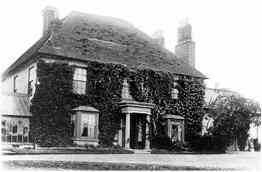
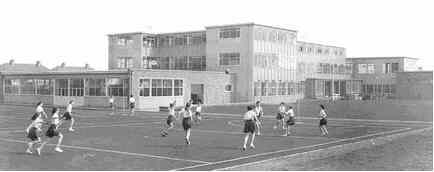
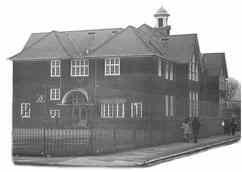
Barton Peveril 1918 Barton Peveril Grammar School 1957 (College from 1973) Eastleigh County High School 1932
____________________________________________________
Issue No. 52 Winter 2014
*****************************************************************************************************
The Magazine for ex-pupils of Eastleigh County High School & Barton Peveril
*****************************************************************************************************
Editorial Comment
Hello again and welcome to Edition 52 of your Magazine. I have been editing since 2004 ! and this issue has been the most difficult to “bring to life”. We have however been helped by Michael Arnold from Australia sending the opening chapter of his new book which makes good reading and must, I feel, raise comments from you. The College seems to get bigger and better each year and Jonathan Prest caters now for about 2.900 pupils (it’s not like the old days !). Eastleigh comes under scrutiny with contributions from Ron Thomas and Henry Lassiter following his recent trip to the UK this summer. Please don’t miss John Foxwell’s write up following his production of “Young Words”. There is also a sample to make you think how times were in the 40’s compared to today. Is there any difference ?
I take this opportunity to wish you all a Very Happy Christmas and a peaceful 2015 to follow. I so hope you will join us for our Christmas Meal in December. Details will follow soon. CHC
Barton Peveril College Today
College got off to a good start this academic year with some wonderful exam results and hundreds of students moving onto universities up and down the country: 66 to Southampton whilst 23% of those going to university lined up for Russell Group Universities - the more research intensive institutions.
National research revealed this year that Barton Peveril students who went to the Russell Group of universities and left in 2012 did exceptionally well with 30% getting first class degrees against a national picture of 20%. I take this as evidence that we are not just preparing students for their A levels but equipping them to thrive at university.
We have grown in popularity this year with just shy of 2,900 16-18 year olds studying here. Most pleasing of all was an increase in the numbers from local schools in the Eastleigh Borough choosing Barton Peveril: many more from Chandlers Ford, Fair Oak, Bishopstoke, Eastleigh and Swanmore.
Over the summer we demolished the Tennyson building, constructed as recently as the 1980s but with classrooms too small to accommodate modern sixth form classes. Gone are the days of 12-16 in an A Level class; our classrooms have to be suited to 20-22 students. In its place we have planning permission to build a new Science Centre. Work will start in December and it should be completed in September or October 2015.
Our final piece of news is that A Levels are changing. Whilst Mr Gove has left office he has not done so without leaving his mark. Instead of studying an AS in the first year, banking the marks and then moving on to an A Level in year two, students starting in 2015 in the first wave of subjects will only be examined at the end of their second year. Old Bartonians may be forgiven for thinking the Gove model sounds familiar!
Jonathan Prest, Principal BP College
Michael Arnold (1945 - 1953), has rallied to my call for more content, from members, for our Magazine. His contribution follows, representing the first part of the opening chapter of his next book, Imperial Atrocities. The chapter is entitled The Cultural Conceit of Colonialism. I am sure you will find his article interesting - perhaps controversial - don’t hesitate to relate all of your ideas concerning any of the points of view that Michael has expressed. He will be glad to “take the stand” and discuss !. Ed.
At the Nuremburg Trials at the close of World War II two German admirals, Erich Raeder and Karl Doenitz, were convicted of what were described as ‘waging aggressive war’, ‘crimes against peace’ and ‘crimes against humanity’ and each man was sentenced to a long period of imprisonment. It is interesting and illuminating to consider the circumstantial perspectives of their alleged ‘crimes’ as against the history of several of the nations who were sitting in judgment.
On that Nuremburg panel, and sitting in judgement, were the representatives of Britain, America, Russia and France; they were the victors in the war against an expansionist Nazi Germany, and the word ‘expansionist’ should be emphasised because had Adolph Hitler confined his weird and bestial philosophy to within Germany itself, there would have been no war. The waging of aggressive war was not unique to the Nazi regime, because for some centuries the fluctuating prides of the world’s most sizeable colonial powers, Britain and France, had largely rested almost entirely on successful aggressive wars, and frequently wars against each other. So when, it might be asked did ‘aggressive war’ become a crime? And in who’s eyes?
In this context there is yet another uncomfortable dimension to the question ‘in who’s eyes’. Admiral Karl Doenitz had been in charge of Nazi Germany’s U-Boat fleet during World War II. When one of his U-Boats, U852, commanded by Kapitanleutnant Hienz-Willhelm Eck, sank a Greek freighter in the South Atlantic in 1944, the ships’ survivors were machine-gunned as they clung to rafts and life-boats in the water in order not to leave any evidence of U-Boat activity in the area. In 1945 Eck was executed by British firing squad as a ‘war criminal’.
Three years before the action of Eck’s U852, Lt. Commander Anthony Miers, in charge of British submarine HMS Torbay, for the same reason had fired on the survivors of two ships he had sunk in the Mediterranean. Miers made no attempt to conceal these two events and recorded them in his logs but in his case he merely received a strongly worded reprimand from the Royal Navy. Miers retired from the navy fifteen years later as a Rear Admiral. The action that the German, Eck, had taken in the South Atlantic was identical to that taken three years earlier by the British Miers. The unavoidable conclusion must be that this was nothing less than a glaring example of ‘victor’s justice’; there was no matter of judicial principle in this, it was simply a question of which side had won.
It might also be added that the fact that France was sitting in judgement on the Nuremburg panel was at the very least, equivocal. Not only had she contributed virtually nothing to winning the war in Europe, but her Vichy regime had enthusiastically collaborated and assisted in the racist policies of Nazi Germany, and had done so to a far greater extent than any other occupied European country. Vichy France had also assisted Japan’s occupation of what was then French Indo-China.
Britain’s Indian and Burmese Empire had been acquired almost entirely by way of ‘aggressive wars’ and France’s Indochinese domain was also taken by military force. Britain’s Ashanti wars were fought for control of the eponymous Gold Coast (now Ghana) and the wars against the Boers in southern Africa had been nothing more than a pretext for control of massive mineral wealth. In each of these areas brutal wars of conquest had been aggressively fought. The most recent colonial conflict – the Second Boer War - had been fought only some forty years earlier. Even after the First World War the League of Nations Covenants, whilst exhorting all signatories to desist from aggression, made no mention of it being a crime. So, although not in any manner intending to exculpate Nazi Germany’s aggression, it does look as though ‘aggression’ relies on the perspectives of individual interpretation rather than any strict definition. In other words it depends on who is doing what. Just when is Imperialism justified?
The Nuremburg Trials concerned only Nazi Germany. Italy had been a co-belligerent of convenience but although having waged aggressive wars from 1935 onwards in Ethiopia, North Africa and in the Balkans she had seen the light and changed sides in 1943, so she could hardly be called to account on the same lines as Germany. Whether this is significant or not, a ‘War of Aggression’ seems to have become an international crime only after the various colonial powers had settled and agreed their respective domains. It could be retrospective as far as Germany was concerned, but no further, and therefore the main global players could view their existing holdings with impunity and without fear of any repercussions. But what was the position of a country that sought and felt it was entitled to similar overseas territories? Was what had been legal only forty years ago now unlawful? And were all the crimes brought before the1945 War Crimes Tribunals worse in style and/or degree than what had gone before? It may seem an unpalatable suggestion, but it does seem that ‘aggressive war’ was only a crime if you lost.
When, in 1942, the Nazi SS Protector of Bohemia & Moravia, Reinhart Heydrich, was assassinated by British trained Czech partisans in Prague, the Germans responded by wiping out the whole villages of Lidice and Lezaky, killing 190 with a further 300 being dispatched to concentration camps. At the time the reprisal was quite rightly condemned in Britain as an atrocity, but where in principle is the fundamental difference between a reaction against one power that has illegally occupied by force, and another? Perhaps this is an uncomfortable analogy but as we shall see the British, French and Dutch responded to independence movements in their colonies with a brutality that was at least the equal of anything devised by Adolph Hitler and his henchmen. In each case these nations had obtained control of their territories through the use of force; double standards seem to have been at work.
At the turn of the 20th century the very – British at least - idea of ‘Empire’ and ‘Colonialism’ was lauded, not as any form of profitable or even cynical enterprise, but purely as a noble obligation and the high-flown morality of the concept was encapsulated by Kipling in his ‘White Man’s Burden’, written for the Diamond Jubilee of Queen Victoria in 1897. Although Germany was relieved of her overseas possessions after the First World War, Colonialism held unchallenged sway for the next twenty years and in general was justified by the accepted inherent superiority of the European so neatly encapsulated by Kipling – ‘new-caught, sullen peoples half-devil and half-child’ -the respective Colonial powers vying with each other in their individual but ‘sacred’ national missions.
The change was particularly evident in Asia where white colonial powers, Britain, France and Holland, had been soundly defeated by an Asian power, Japan. In Europe also, colonial powers France and Holland had themselves actually been defeated and occupied by Nazi Germany. That Japan was eventually defeated, and then almost entirely by America, didn’t alter the fact that the prestige and standing of the white man had been irrevocably diminished. France lost moral stature in her overseas territories when the regime of Vichy France actively collaborated with the Nazis and also with the occupying Japanese in Indochina. In other parts of Asia Indians, Burmese and Javanese were, quite logically, asking whether the ‘Atlantic’ Charter didn’t apply equally to the ‘Pacific’. It did of course, and despite the best efforts of Winston Churchill, Independence for India arrived within two years of the War’s ending.
It had been Churchill who had thumped the Empire drum at his first meeting with Roosevelt in August 1941 (before Japan entered the war). Provoked by Roosevelt’s insistence that the ultimate successful conclusion of the war must include freedom of trade and the development of backward countries, Churchill had retorted that it had been her Empire that had made Britain great. Fortunately for Churchill, Roosevelt was a tactful man for the obvious response to this sort of bombast would have been to ask him if Britain was so ‘great’, then why was he now holding out his begging bowl to the United States.
The aftermath of the Second World War however forced a significant change in attitudes and world opinion. Due to economic and political pressures and the Right to Self-Determination principles as set out in the 1941 Atlantic Charter, the various Colonial powers found themselves facing determined independence movements. Although these causes were supported by the tacit encouragement of the United States, American pressure was nothing like what it would have been had Franklin Roosevelt not died in April 1945.
Roosevelt’s views on colonialism are well documented and had he lived he could have exerted considerable influence with regard to the future of the French and Dutch possessions in Asia. Talking to his son Elliott at Casablanca in January 1943 he had remarked: ‘When we’ve won the war, I will work with all my might and main to see to it that the United States is not wheedled into the position of accepting any plan that will further France’s imperialistic ambitions, or that it will aid or abet the British Empire and its imperial ambitions
Roosevelt’s Fourth Term would not have expired until 1948. He could have done little to induce any change in the British territories because Slim’s 14th Army had taken Rangoon in May 1945 and was then planning a final assault to retake Malaya, but in the Dutch East-Indies and French Indo-China Roosevelt could easily have deployed American troops to forestall the re-appearance of their erstwhile rulers. It is of course speculating, but had he prevailed the horrendous Vietnam War might never have occurred and thousands of lives would have been saved in Indonesia. Both Truman and his Secretary of State, James F Byrnes had pre-conceived anti-Soviet views and so a different die was cast.
The truth was that although capable of suppressing the dissent of a few spear throwing natives, when faced with someone her own size the greatness of the British Empire was shown to be a self-deluding fiction that could not survive without outside help. Britain’s industrial strength had been built on raw materials from captive colonies and manufactured exports to monopoly markets, a protected and artificial position that was exposed when independence came to her colonies and she became open to the realities of global competition. By world standards most British industries, although large, were neither efficient nor competitive because their shielded position meant they didn’t need to be.
The hollow pretence of the British Imperial image was eloquently laid out by historian Barbara Tuchman when she wrote: “No nation ever produced a military history of such verbal nobility as the British. Retreat or advance, win or lose, blunder or bravery, murderous folly or unyielding resolution all emerge alike clothed with dignity and touched with glory. Every engagement is gallant, every battle a decisive action. Everyone is splendid: soldiers are staunch, commanders cool, the fighting magnificent. Whatever the fiasco, aplomb is unbroken. Mistakes, failures, stupidities or other causes of disaster mysteriously vanish. Disasters are recorded with care and pride and become transmuted into things of beauty. Other nations attempt but never quite achieve the same self-esteem. It was not by might but by the power of her self-image that Britain in her century dominated the world’
This assessment of pukkah complacency is graphically confirmed by an eye-witness account of a press-
conference held at the Imperial Hotel in New Delhi in April 1942. Suspicious of the anodyne accounts that they had been fed of what had been described as the army’s ‘evacuation’ of Burma, a British reporter asked American General Stilwell if he could clarify such British phrases as ‘an heroic voluntary withdrawal’ and ‘a glorious retreat’.
‘I certainly could’ Stilwell snapped in a cold, incisive tone. ‘In the first place, no military commander in history ever made a voluntary withdrawal. And there’s no such thing as a glorious retreat. All retreats are as ignominious as hell. I claim we got a hell of a licking. We got run out of Burma, and it’s humiliating as hell. I think we ought to find out what caused it, go back, and re-take Burma. That’s all, gentlemen. Good night!’
Stilwell’s description was totally accurate. There had been nothing lacking in the fighting quality of the troops, but they had been led by a collection of courteous, incompetent nonentities, men for whom the army and its revered protocol provided a respectable profession – provided they didn’t have to fight.
The British smugness would collapse against uncomfortable truths following World War II. This was most dramatically revealed with the rapid decline of the British motor industries and the virtual disappearance of her once great motor-cycle companies when complacent manufacturing entities suddenly found themselves exposed to new ideas and efficient competition from which they had always been protected.
But it was not only in the actual granting of Indian independence that a change in attitude was seen, for it was – gradually and grudgingly perhaps – accepted that movements for independence were not necessarily criminally subversive. Gerald Seymour’s 1975 book, ‘Harry’s Game’, about the IRA and Ireland saw a fresh interpretation in that it was quite possible for a genuine freedom fighter to be a terrorist for the simple reason that he had no other means available. The telling phrase penned by Gerald Seymour was:
‘One man’s terrorist is another man’s freedom fighter’
It was a valid point of view but one that was contemptuously dismissed out of hand by establishments as nothing more than an author’s imaginative licence; it was only fiction anyway, so who cared? But many did care, many quoted it and many started to view current events and earlier issues in a different light. It was an uncomfortably moot point that colonial freedom fighters were, in principle, no different from the French Resistance or the Dutch Underground during World War II for they were all fighting an illegal foreign occupation. Both of these entities received consistent support from Britain, herself still a colonial power.
Thank you indeed Michael. There must be something in your writings that readers can get their teeth into !
Your promise of more to come is appreciated. Ed.
Ron Thomas (1957 - 1962) sent an article which appeared in Issue 49. Ron admitted that he had not contributed for about 8 years. He must have caught the habit for here is his latest piece, entitled “Routes and Memories”………….
"In a few years time the pleasant views seen from these walks may be considerably altered due to the ever increasing need for urban and industrial development . This is an observation made by Peter New in his booklet edition 'Revised, Amended and Extended' by Gordon Cox in 1984. I suppose every age looks back to note, approve or lament the changes that have appeared within living memory, and even beyond that! Looking back at the time over fifty years ago (pity help me) when I made the daily trek from Ruskin Road to Barton Peveril, I can now conjure up an even greater appreciation of the warning given by Peter New.
'Now to begin not quite at the beginning! 'Apologies to Dylan Thomas.
There were two routes I could take. If I were feeling particularly energetic, I would walk, or even occasionally run, as a form of training for rugby(!), the route via Archers Road and probably Nutbeem Road. Otherwise I would go on my bike via Salisbury Arch.
From the top of the footbridge, linking the footpath from Shakespeare Road to Archers Road, Peter New could remember "At night walking over the railway footbridge seeing the flashing lights, hearing the loud organ music and catching the smell of the showmen's steam engines far beyond Shakespeare Road towards Boyatt." This was the site for Eastleigh's annual carnival fair in the thirties. Before that "the fair was held at Nutbeem's Farm, which was formerly Great Eastley Farm (now occupied by Pirelli- General) and prior to the Great war the century old Ginnetts Touring Circus chose Chamberlayne Road for its sight."
Fifty years ago, it was still possible to stand on top of that footbridge and look across the open fields towards the Eastwood brick works and the wooded surrounds of the Rookwood maternity hospital. Who would have thought that before Rookwood closed both my sister and my wife would give birth to their respective daughters under its roof? I am reminded though that our daughter nearly arrived before my wife got to the doorstep but that's another story! Look now from the footbridge and 'all' you can see is the complete development of Boyatt Wood, and if you are extremely lucky, you can enjoy the tone of what was originally described as the Chandlers Ford bypass. I do believe it is known as something else now. However, to be fair, there was a need for the housing and until the coming of the railway Eastleigh did not exist as a town or even much of a village. Everywhere has to be new once!
Still, returning to the footbridge and the route to Barton Peveril , Gordon Cox in his revision to the original text of Peter New reminds us that, "Archers Road was developed during the coronation year of George V,1911, and became part of the 'Newtown district’ Emerging from Archers Road, you would of course see the 'Rec' and the bandstand that was erected at first without a roof" and where "This “lung” of Eastleigh became more than just an open space with the planting of shrubs and flowers and the laying of paths" But if you went around Romsey Road and into Leigh Road now, where would be the great employers of the town? The printing works of Sir Joseph P. Causton and Pirelli General are now both long gone and along with them the notion of Eastleigh as a productive industrial town. Many will also know that further along Leigh Road was the site of Prices bakery where once I spent three weeks of my 1966 Easter college vacation throwing sugar over eleven thousand cakes a day. But this of course would not be on my route as it would be the other side of North End School , but throwing sugar over that number of cakes in Eastleigh should be a formative experience not to be forgotten in any memory of nearly fifty years ago.
So what about my cycling route via Salisbury Arch? There would be the council yard at the end of Shakespeare Road where again I subsequently spent a couple of vacations picking up some temporary work for eight or ten weeks. Imagine being able to do that now, or indeed having no trouble at all in picking up almost any kind of work to 'tide you over'. Anyway, suffice to say that the yard has now gone, as has the Crescent school that used to be just the other side of Salisbury arch. Also worth noting is the change in the use of the Parish church at the corner of Romsey Road.
A happy memory of this route concerns one of the shops to be seen on Station Hill. It was a model shop full of the splendours of plastic and balsa wood aeroplanes and ships. To complete a balsa wood model covered with tissue between the skeleton of the wings and fuselage, it was necessary to cover the whole thing with a pungent sticky liquid that would harden and enable the aircraft to fly. Oh! dear, it was called dope. Try explaining that nowadays!
Normally however I would not go via Station Hill, but would turn right into Romsey Road. On the corner of Market Street and Romsey Road would be an uninspiring looking small hall, or large hut, depending on how you thought about it. This was the site of the parcel distribution centre for Royal Mail every Christmas, and you could get a job for 2/6 an hour, or even 3/6 an hour, if you were over twenty one. After a hard days work delivering parcels, the object would be to get as many hours a day in by any means possible. A good wheeze would be to make sure you were loading the last lorry of the day and then go around to the railway station to unload. One night this really went too far when six students arranged for themselves to be buried under the sacks. However , the supervisor was on to this as there appeared to be rather too many people not signed off for the night "I know you lot are under there. Out!" came the cry. At this point I think I must reveal, even to those of a more sensitive nature, that the term used was not actually lot, or even Bartonians. Slowly the sacks trembled and then parted. Six employees departed into the cold night. I had not been buried but had got into the cab along with Dave Scoular. When the driver opened the door he exclaimed "Oh! God, there are more of them!" Still, we got to the station that night!
Getting back to the journey on my bike, a route along Market street would now be a catalogue of landmarks long gone. The Eastleigh Institute with its tennis courts at the back , the Regal , the Picture House and Bennetts record shop among many others. Turn right into Factory Road and on the corner of High Street and you will look in vain for the CO-OP building on the corner with High Street. Gone is the building that attempted to emulate, according to the then managing secretary, the "Sweep of the Queen Mary".
What else is there left to say? You could do a lot worse than to be off to Chestnut Avenue to see the definite improvements to Barton Peveril!
Do try and get hold of the booklet that has triggered all these thoughts. I feel very lucky to own the edition I have because at the AGM in 2006 Gordon Cox kindly signed my copy. Thanks indeed Ron, most enjoyable - are there any more memories of times past ? Ed.
_______________________
It is with regret that we have to report the passing of D.A. Alan Baker (1940 - 1948) who sadly died at his home in Bath on 14th August. Every Old Bartonians Football Club player will have the most happy memories of Alan - a great footballer.
__________________
Henry Lassiter (1946 -1950) has sent the following from the
USA. His title is “A Saunter around Old Eastleigh”…………. “This
past summer I spent a little over four weeks in England. This is my longest
spell in England since my wife Sylvia and I emigrated to the United States back
in 1961. While I was in England I visited friends and relatives throughout the
country including a very enjoyable mini-reunion lunch with my former Old
Bartonians football colleagues (see photo in the Summer 2014 edition).
I am left with many memories, not the least of which was the marvellous weather. If I didn’t know better I would be tempted to say, “What is all this rubbish about England and bad weather!”. I experienced just a few belated showers on about four occasions! During my travels I visited two unique establishments. In the delightful village of Chipping, Lancashire in the beautiful Ribble Valley area just north of Preston, I visited what is claimed to be the oldest continuously trading shop in England. Reputedly it has been operating since 1668 - remarkable indeed. Then, at the opposite end of the country, while visiting friends in Dorset, we were in Bridport where R. J. Balson proudly claims to be the oldest butcher’s shop in England, established in 1535 and still operated by the same family.
I am not going to get into a dispute with the shop in Chipping, Lancashire over longevity. Let's just say they are both very old! Visiting these historic establishments - still flourishing I might add - it made me wonder about our little town of Eastleigh. (I know many will argue that Eastleigh is no longer little in that sense, but I refer to the homogenous town that existed in the 1940s and 1950s which I knew as my home town - where I was born and grew up). Given those criteria, I think about the businesses and shops that existed then - what happened to them and how many might still be in business today. I hasten to add this is a whimsical meander through my memories that is not intended to correlate with hard facts and dates. Indeed, despite the fact I was in England for over four weeks this summer, I did not once visit the shopping district formed by Market Street, Leigh Road, High Street and Factory Road. This was the hub of the town in those days - except for a few extensions from each of the cross roads formed by these streets - before the town became endless rows of terrace houses spreading in many directions.
Consequently, my observations are from my 1940s and early 1950s recollections only. Let’s take a starting point of F. W. Woolworth (affectionately known as “Woollies”) - at the time a global store chain that sadly no longer exists - at least in England. (In researching this article, I find there are some countries in which the Woolworth name is still used). I remember the Eastleigh Woolworth for its creaky wooden floors and stained, wooden displays of everything that one could imagine - and in those days claiming nothing costing more than sixpence (or was it a shilling?) Next, proceeding west along Leigh Road, as I remember, was Bazeley’s flower shop. Joan Bazeley was in my form at school. The Bazeley’s shop is long gone I suspect. Next, or close by, was Webb’s the photographer, a jewellers shop, which I don’t believe I ever had occasion to enter.
From there to the corner of High Street my memory beats me. I cannot remember the names or type of shops. However, I do remember across Leigh Road from this corner in the entrance to the recreation ground (affectionately known as the “Rec”) stood a large shed (or it seemed large to me). This shed had three sides with the other long side open. As I recall the inside three sides was lined with a bench always filled with old “codgers” sat chatting. I used to wonder at these old “codgers” little thinking that one day I could be one of them and, if the shed still existed, that I could be sat with them reminiscing of what used to be! Across the street on the west corner of High Street and Leigh Road was Bartons the feed shop - an intriguing place with its sacks of various kinds of “stuff” arranged outside. I don’t recall ever having a need to have any business in there, but remember the shop distinctly.
Moving down High Street my memory fades as to which shops were on either side until we reach Fellows the leather shop - one of two leather shops in Eastleigh, the other being on Market Street (perhaps the other one was called Fellows?). Anyway, one could buy all manner of leather goods in there and I can still recall the rich aroma of leather wafting from the shop. I remember when they received their first consignment of fireworks after the war and the excitement it caused as crowds of children lined up for their first chance to buy fireworks. Now I think I am getting ahead of myself, wasn’t there a chemist shop and a small sweet shop before Fellows - or am I imagining it? Beyond Fellows until the Post Office my memory is a blank. Unless it has moved, the Post Office is still there - and probably remains just as crowded as ever it was! Behind the Post Office - I am not exactly sure where because as a boy I never had occasion to visit the establishment - was the home of the Eastleigh Printing Works and the Eastleigh Weekly.
Across the street from the Post Office, in no particular order that I can recall was an Evangelical Chapel, the pork butchers (did they only sell pork products?) and the Salvation Army Hall. I believe Stubbingtons furniture store followed on from there, or did the Cosmo cafe fit in there somewhere? I remember Pete Pelon who worked at the Cosmo. He was a refugee from the Spanish Civil War and played football locally. Carrying on down the west side of High Street I can vaguely recall a chinese laundry. Our esteemed editor who is a few years my senior may recall this little shop. I believe the name was Quong Lee - or am I fantasizing? (Help Cecil! Or anyone!) You are quite correct ! Ed.Carrying along the east side of High Street from the Post Office was a place of infamy for us boys growing up - Eidermans (sp?) the barber. During the war he was just about the only barber in town (Actually there was another farther down on Market street by the name of Gardner). On Saturday mornings we would sit for what seemed hours while Mr. Eiderman “styled” our hair - everyone getting a “short back and sides” no matter what they expected. I remember he had no modern equipment, using hand clippers only. Most of all I distinctly remember him periodically blowing loose hair from one’s neck with his hot breath. Ugh! Then there was Torbocks the grocers - said to have originated the idea of supermarket shopping, or at least introduced it to Eastleigh. I don’t recall what was there before Torbocks, but wasn’t there a small newsagents wedged in there somewhere? memory is hazy again from there to the corner of Factory Road, wasn’t Leightons the opticians somewhere along there (and may be still there for all I can recall) and maybe a fish shop also?
Turning the corner onto Factory Road, am I correct in thinking there was a draper’s shop on the corner - full of knick knacks and haberdashery - or again is my memory playing games? Before continuing, allow me to digress - diagonally across from the High Street/Factory Road corner was an Eastleigh icon, Hillikers Fritter shop. The place was quite amazing. It certainly couldn’t have passed any of today’s clean food standards. It served faggots and mushy peas, but the specialty was its fritters - sliced potatoes dipped in batter and fried in probably the most rancid animal fat one can imagine. Yet we craved for them! We would line up for hours just for a few pennyworth! Farther down High Street was Wilding’s the ironmongers where we would get our paraffin cans refilled. Then across the street was the “Co-op” (Eastleigh Cooperative Society) with its bakery (those lovely lardy cakes!) and then the department store with its art deco facade.
Now back to Factory Road. Next was one of our early favourites - Ruscillos the ice cream shop, but during the war and shortly thereafter I am not sure what they served for ice cream. Next was a “new” shop (or did it replace Ruscillos? I can’t remember) - Boyce’s the men’s shop - its window filled with the latest shirts, ties, trousers, suits and other men’s clothes. I call the shop “new” although I don’t know what preceded it, but I do remember that it wasn’t always there. I have a feeling it may still be there (a different name perhaps). It certainly is no longer “new”.
The next place I remember was Longman the barber shop. The shop was closed during the war since Mr. Longman was in the armed services and it didn’t reopen until after he returned from the war. I remember his daughter Iris graced my class for much of my time at Barton Peveril. I remember her tightly woven plaits that we boys longed to pull! Continuing along Factory Road toward Market Street, on the south side, if I am not mistaken, was the cookery annex for Chamberlayne Road Senior Girls School. My wife Sylvia learned some of her cooking skills there. On the corner of Factory Road and Market Street as one turned north, on one side was the grocers Misslebrook and Weston. I am not sure I ever went in there since we did our daily shopping closer to home. Next door was Ayleys the bicycle shop where there was always an array of bikes for sale plus sundry bicycle related items. Next door to Ayleys was Wainwrights the chemist shop. Wainwrights was there for as long as I can remember and may still be there. The father of one of my early friends in the Cubs, Graham Taylor, was the chemist there. Graham and I lost touch with each other since I believe he went to Peter Symonds School in Winchester. Also, I remember once on a trip back to England that Sylvia and I made - probably 20-30 years ago - we were passing Wainwrights when an assistant rushed out and started talking enthusiastically to us. Shame on me I cannot recall her name now, but her maiden name was Maureen Cattle. We knew her as teenagers. She worked at Wainwrights for many years. I would never have recognised her, but she knew us!
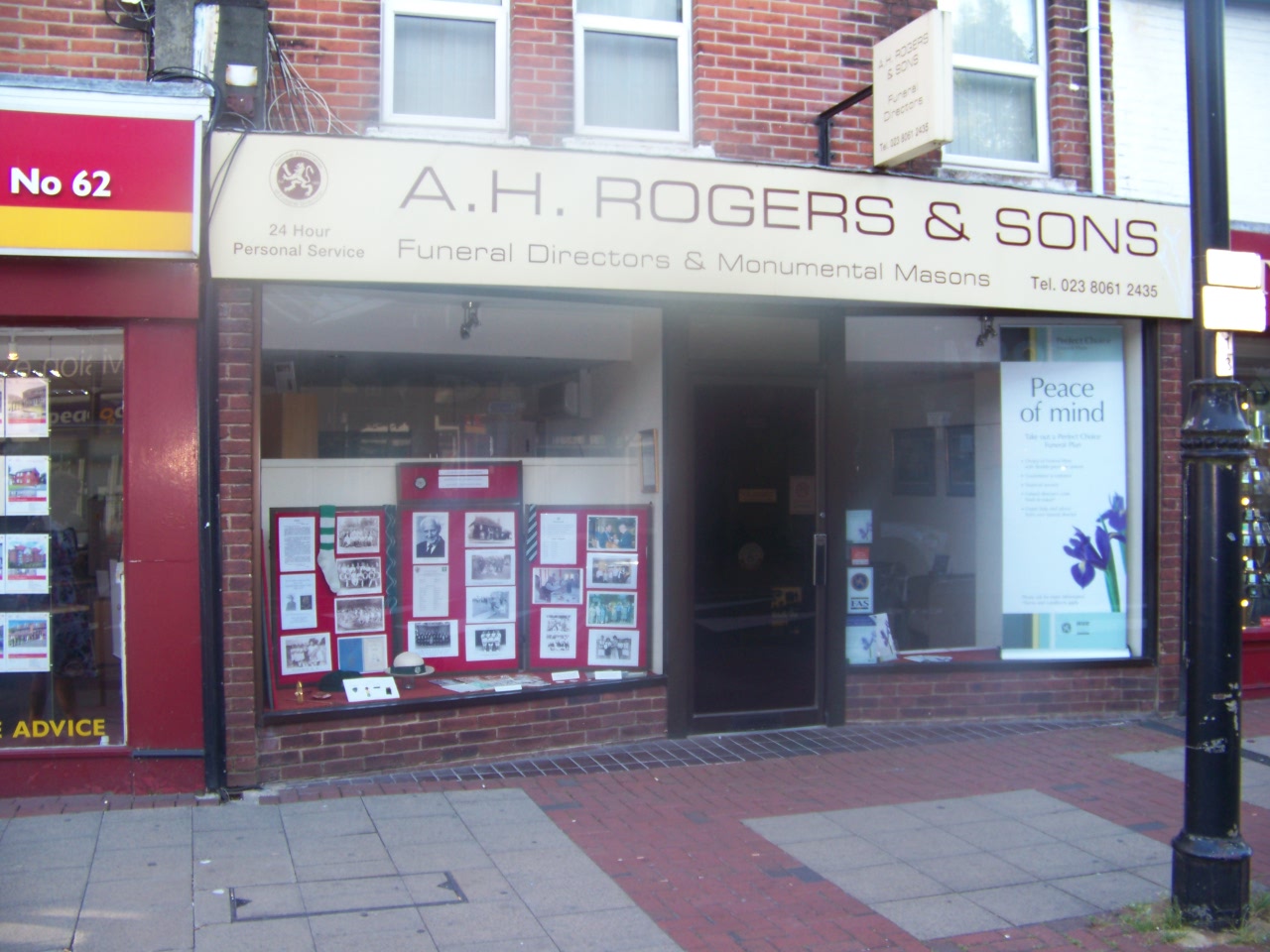
Old Barts’ Display 2013
Across Market Street was the always busy greengrocers Peacocks. Now I am stumped. I cannot recall the shops before or immediately after Peacocks. On the north side was a long time jewellers (it may still be there), but its name eludes me. Then there was the other leather shop in Eastleigh. This, as I recall, was a little shop that catered to “do-it-yourself” cobblers. I know my father bought leather there to repair our shoes.
Across from there was (and I believe still is) Rodgers the undertakers. Rodgers once played a strangely coincidental part in our lives here in the United States. About 30 years ago at a social function in San Diego where we live we met a couple and in chatting (I might add they were American) they said their son lived in England. In our discussion we found out he actually lived in Eastleigh, and further, that he worked in Rodgers! We never saw this couple again. Consequently we were never able to follow up on this coincidence and in visits home we never casually stopped by Rodgers to find out (one doesn’t casually stop by an undertakers, does one!). Beyond Rodgers I lose myself again. Wasn’t there a bakery which sold tasty cakes of all sorts somewhere along there? On the other side of Market Street after the jewellers, among some other shops, was the Scotch Wool Shop and another newsagent. This is the shop where I had my first job delivering newspapers. I wasn’t one of the elite who worked for W. H. Smiths at Eastleigh station. I worked in this gritty little newsagents - I can’t even remember its name! The next major shop on this side of Market Street was (and still is I believe) Boots the chemist and then Burton the tailors. In working class Eastleigh I am not sure how Burtons survived. I never knew anyone who actually bought anything in there! It’s still there ! Ed.
Continuing north on Market Street we come to the icons of pre- and post- war Eastleigh - the cinemas - the Picture House and the Regal. Many is the time we would queue up outside (often in the rain) on a Saturday night to see our favourite movies with our favourite girlfriend - in my case always my dearest Sylvia. I even remember on occasions Gordon (?) Wright playing the magnificent organ in the Regal. What memories! Wasn’t there also a little sweet shop squeezed in alongside the Regal cinema? I do believe there was. Now the last shops on Market Street as it reached Leigh Road. On the east side there was Dewhurst the Butcher’s and Smith Bradbeer (isn’t that still there?) Then across the street the corner store was Bakers Men’s shop if I remember correctly. As one turns the corner onto Leigh Road and before completing the circuit of Eastleigh’s shopping district we have Hill’s Fishmongers where Old Bartonian Don Hill served in the family business. As I think about it though, wasn’t Hill's alongside the Picture House on market Street - just before Bakers? I believe it was. Pardon my memory, Don!
I cannot finish without a nod to another iconic piece of old(er) Eastleigh - the Railway Institute - which was located on the north side of Leigh Road at the junction with Market Street. That corner is where the Old Bartonians Football team would often meet for transportation to away games. Now it has disappeared and replaced by the supermarket Sainsburys. Well I have finished my meander around the old town centre of Eastleigh. As I was writing this, I came to realize just how little detail I can actually remember of Eastleigh of the 1940s and 1950s. Other shop names come to mind, such as Clemoes and Frisbys, Lennards, Bata - the latter three all shoe shops, but I cannot place them now. I invite those who have better memories to correct my errors and to fill in the spots where my mind is a blank. For the errors I offer two excuses - one my near 80 year old brain, and two, that I essentially left Eastleigh in 1953 when a very young Queen Elizabeth II invited me to spend two years in her service (and that is another whole story...) For a look at Eastleigh from those days, you can view a series of 28 photos on the Francis Frith website
<www.francisfrith.com/uk> Just insert Eastleigh, Hampshire in the search box and click.
What more could we ask ! Thank you Henry for your saunter - I feel it raises several questions………can any readers help Henry with those gaps that Henry has highlighted ?
John Fox well (1945 - 1952) sends the following…………..”At the AGM in May last year, John Barron had copies of the School Magazine, the “Peveril”, on display. Following discussion with John I agreed to have a go at transcribing these magazines for inclusion on the Association’s website (www.bartonians.uni4m.co.uk). Now you can view many of the magazines over the period 1950 to 1958 on that website.
The “Peveril”, edited by a team of senior pupils, was published usually twice a year. Its main perhaps was to record the goings-on of the previous few months, including external exam results, the sports results (not always the most pleasant of reading) of netball, hockey, football and cricket matches between the school and other Hampshire Grammar schools, the reports of the activities of the numerous societies and changes in teaching staff. These make interesting nostalgic reading, particularly for those of us around at the time. However, these goings-on are now, very much, “yesterday’s news”.
But of far greater significance are the original literary contributions by many pupils, both in poetry and prose, usually four or five in each issue of the Magazine. I have put together a collection of these writings entitled “Young Words”. These short stories and poems were written by pupils in the age range 12 to 18. The quality of the writing often reveals the amazing imagination and compositional skills, both in prose and verse of the young contributors and is also a testimony to the outstanding they received.
There are 205 contributions consisting of 95 short stories and 110 poems written by 176 boys and girls noting that some authors made several contributions over various issues. The earliest in this collection are from the year 1940, just after the outbreak of WW2. Succeeding articles were written throughout the war and you will see various references to wartime conditions - for example, the blackout, the air raid siren and food rationing. This rationing also applied to paper which restricted the magazine to a limited number of pages so that all articles submitted could often not be published - no doubt a disappointment to both the Editor and the contributors. Rationing of course continued long after the war ended. There is a delightful poetic parody, taking off the famous speech “This Royal throne of Kings” in Shakespeare’s play Richard II.
This royal land of kings, this sceptre isle,
This land of rationing, this hungry realm,
This land of whalemeat, sausages and snook,
This fortress built by Churchill for himself,
Against inflation and the hand of Cripps,…….etc !
The subject matter of the articles is very varied but usually relating to the personal experience and feelings of the author. These can range from very evocative observations of aspects of the natural world and the behaviour of one’s pets, to very interesting and descriptive journeys home and abroad.. As well there are a number of short stories of mystery and suspense, often with an element of fear engendering some apprehension as to the outcome. For example, the spy, when cornered by the security services in an upstairs room of a tall building confidently announces his departure by stepping out of the window and dropping down a floor on to what turns out to be a non-existent balcony ! (refer to Pages 5 and 6 in Issue No.51. Ed.) There are a number of contributions concerning life at school - observations on school assembly, daydreaming in class, the school council, a report of a hockey match between the girls 1stXI and Staff, a nightmare, reflections on leaving school and many others. In a number of articles unusual names appear - these are usually the names of teachers - for example, “The Old Man” refers to the Head, Mr. H.N.R.Moore, who was Headmaster from 1936 to 1963. “Sam” refers to the physics master, Mr. S.Bodey. However, other names refer to pupils. Perhaps the most notable is the poem dedicated to “A dear little friend” - a parody on “Who killed cock robin” The second two thirds of these writings after the War cover the period up to 1958.
Strikingly, although written in difficult times, both during the war and the immediate post-war period the firm impression given by all the articles. Besides being of interest to “old” pupils I believe it will be interesting and entertaining to today’s children, certainly to your children and grandchildren. I have produced a limited number of “Young Words” in a book of 184 pages. Copies are available at a cost of £10 (this includes a £1 donation to the Association.
Apply for your copy either to me at
jfoxwell@jfas.demon.co.uk or to the Editor churcher.c@sky.comI happen to know how much work John has put into this for the Association. Please don’t disappoint him. and reserve your copy, in time for Christmas ? Thanks. Ed.
Here is a “taster” of the content of Young Words…….written in the 40’s………but so appropriate today !
For years in this dark world of sin and strife
Men have not lived in peace and joy for long
For in his short stay on this earth man’s life
Is being spent in wars and doing wrong.
They think out plans of gun and plane and tank
To kill and to destroy their fellow men.
They never think to give gifts and to thank
Who gave them power over beast and fen,
And Who meant them to dwell in peace with all.
And yet they never see the joys of peace
Until they are at enmity with all,
And then it is, men wish that bloody wars would cease.
So why do men indulge in bloody war,
And so the beauty of the fair earth mar ?
G.J.WOODFORD (U.V.L.) Age 14 years.
HUMOUR.
An older couple were lying in bed one night. The husband was falling asleep but the wife was in a romantic mood and wanted to talk. She said, “You used to hold my hand when we were courting”. Wearily he reached across, held her hand for a second and tried to get back to sleep. A few moments later she said, “Then you used to kiss me”. Mildly irritated, he reached across, gave her a peck on the cheek and settled down to sleep. Thiry seconds later she said, “Then you used to bite my neck”. Angrily, he threw back the bed clothes and got out of bed. “Where are you going?” she asked. “To get my teeth” !
___________________________
The young couple invited their elderly pastor for Sunday dinner. While they were in the kitchen preparing the meal, the minister asked their son what they were having. “Goat”, the little boy replied. “Goat?” replied the startled man of the cloth, “Are you sure about that?” “Yep”, said the youngster. “I heard Dad say to Mum, “Today is just as good as any to have the old goat for dinner”!
_____________________________________________
Wise Words. Never, under any circumstances, take a sleeping pill and a laxative on the same night.
Don’t worry about what people think, they don’t do it very often. Not one shred of evidence supports the notion that life is serious. Bills travel through the mail at twice the speed of cheques.
Middle age is when broadness of the mind and narrowness of the waist change places. Junk is something you’ve kept for years and throw away three weeks before you need it. Never lick a steak knife.
____________________________________________
The Wisdom of children. How do you decide whom to marry. (by children).
No person really decides before they grow up who they’re going to marry. God decides it all way before, and you get to find out later who you’re stuck with. Twenty three is the best age because you know the person FOREVER by then. Dates are for having fun and people should use them to get to know each other. Even boys have something to say if you listen long enough. On the first date, they just tell each other lies and that usually gets them interested enough to go for a second date.
It’s better for girls to be single but not for boys. Boys need someone to clear up after them.
___________________________________
In this Issue, my thanks go to Michael Arnold, John Barron, John Foxwell, Henry Lassiter, Jonathan Prest and Ron Thomas. Your contributions have gone a long way to “keeping us going”. As ever, more will be needed in 2015 - can you help? Ed.

and Happy New Year 2015 ,
to all Old Bartonians, families and friends.

The Committee looks forward to seeing you during 2015
Friday 8th May - Our Annual Dinner
at Eastleigh College
Saturday 9th May - Reunion & AGM
Please support us by being there !